John Winthrop Quotes
Thou must observe whether thy brother hath present or probable or possible means of repaying thee, if there be none of those, thou must give him according to his necessity, rather then lend him as he requires; if he hath present means of repaying thee, thou art to look at him not as an act of mercy, but by way of Commerce, wherein thou arte to walk by the rule of justice; but if his means of repaying thee be only probable or possible, then is hee an object of thy mercy, thou must lend him, though there be danger of losing it
John Winthrop, 1588-1649, Puritan Clergyman, Governor, Massachusetts Bay Colony, Response to questions about lending money, A Modell of Christian Charity, 1630
Sourced by: Eigen's Political and Historical Quotations


Sherman, at the height of the California Gold Rush, took a private assignment for Moffett & Company, establishing and running an assaying, banking and minting company in San Francisco
Such an interest rate was not considered high, much less usurious.


Most people reading this think at first that if comes out of the Middle Ages, but it is quite contemporary expressing a point of view that holds that the state is but the instrument of and subservient to God as defined by Protestant Fundamentalism.

Interest is forbidden in all transaction, both business and personal.
Those who devour interest will not stand except as stands one whom Satan has driven mad by his touch
Interest is forbidden in all transaction, both business and personal.


He was the only English Pope. This was the authority that enabled English King Henry II to invade Ireland. Many historians consider it the beginning of the problems between the Ireland and England which persists to this day. See {610520}. Some scholars think that this bull was a forgery stating that the writing style was different from other bulls of Adrian IV. Opponents believe that a change in secretaries could easily have accounted for the difference.


The level of religious charity would be impressive for modern times. It is a marvelous insight into 14th Century Damascus.

Aymeric (Albert) was a Frenchman who as a result of the Crusades Some historians credit him with founding of the Carmelite Order. The Patriarch was trying to raise more money for the Crusades. The Second Crusade had been a failure. The initial enthusiasm for the Crusades had diminished but the expenses increased. This is one of the more dramatic fundraising requests in history.

This passage was quoted by Colonial Massachusetts Governor John Winthrop in A Modell of Christian Charity, 1630.

The Papacy was at one of it’s lowest points. Two men, Clement and Urban, both claimed the Papacy and each had raised an army to fight the other. Each was promising indulgences to those who would fight, and in a modality similar to the Muslim terrorists of the 21st century, the soldiers were promised ascendancy to Heaven if they fell in battle for such a holy cause. The armies of the popes marched under the cross as their banner, and Wycliffe found that obscene and actually wrote a treatise saying so. See {618087}.
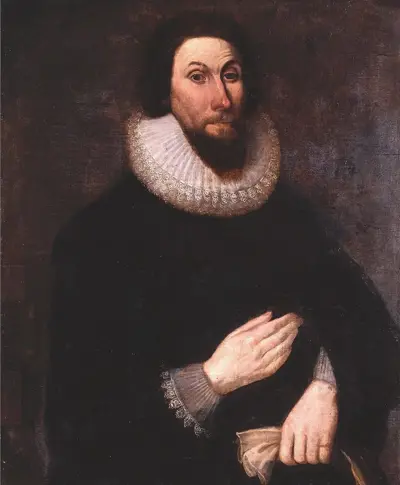
John Winthrop was an English Puritan lawyer and one of the leading figures in founding the Massachusetts Bay Colony, the second major settlement in New England following Plymouth Colony. Winthrop led the first large wave of colonists from England in 1630 and served as governor for 12 of the colony's first 20 years. His writings and vision of the colony as a Puritan "city upon a hill" dominated New England colonial development, influencing the governments and religions of neighboring colonies.
