Muhammad Quotes
Allah curses who requests usury and who gives him usury, the one who writes down the usury transaction and its two witnesses
Interest is forbidden in all transaction, both business and personal.
Muhammad, 571-632, Prophet and Founder of Islam, Sahih Muslim
Sourced by: Eigen's Political and Historical Quotations

Those who devour interest will not stand except as stands one whom Satan has driven mad by his touch
Interest is forbidden in all transaction, both business and personal.
Interest is forbidden in all transaction, both business and personal.
Usury in orthodox Muslim terms means the charging of interest. Modern Islamic societies have developed a variety of methodologies for dealing with the usury prohibition yet functioning in a modern capitalist system. Orthodox Jews also have a Biblical prohibition against loans with interest. Fundamentalist Protestants of some sects also believe that loaning or borrowing money and charging interest is a sin prohibited by God.
Terrorism is not new to Islam. It was proscribed by the Prophet when fighting the “enemies of Allah.” There are those who believe that he was not advocating terrorism as we know that term today. Instead they believe that he meant that they should scare and intimidate the enemies of God, and the sura does not explicitly promote or sanction the murder of innocent civilians. They would interpret this quotation to mean “Attack the military enemies of God so severely that they well fear you and be intimidated.” Others see the quotation as an explicit endorsement of terrorism. What better than beheading or exploding random members of a society that is opposing Islam and Allah in order to “strike terror into the hearts of the enemies of Allah.”

In September of 2005 a Danish Newspaper published some political cartoons showing the hypocrisy of some Muslims who use Islam to justify murder of innocents and terrorism. Months later, in January of 2006 many in the Middle East protested vehemently and Muslim riots broke out because the Prophet Muhammad's visage was depicted against Islamic tradition. Many Muslim nations started a boycott against Denmark. Many Muslim leaders claimed that insulting religion was an “abuse” of freedom of speech including those from nations which regularly publish material that is virulent against Christians and Jews. The Sheikh along with many other Muslims called for the death penalty for the cartoonist who was exercising his Danish right of freedom of expression.
the prophet was hostile to all forms of monopoly which in his time for almost always granted through political corruption and favoritism. Before Christians even considered the issue, Islam considered monopolies anti-consumer and contrary to the interests of the Muslim society.
Innovator in this sense refers to one who innovates within Islam—who tries to change or reform the religion departing from the original message of the Prophet.

Gordon himself was killed shortly thereafter by the Madhi’s followers at the siege of Khartoum. Ahmed died soon thereafter. Although Ahmed was an extreme religious fanatic, and a skillful leader, he was not a terrorist.

Historically, this is an amazing quotation. It is typical of analyses of Islam in the 21st century when America and most of the non-Muslim world was having great difficulties with Islamic militancy. But this was written at the end of the 19th century, in 1899. Churchill had a grasp of much that it would take other politicians a century to understand. This book was relatively unknown to all but a few historians, military men, and political scholars. (There was a shortened version published in 1902 which did not include this passage and that is the version that Project Gutenberg posted on the Internet. So do not assume that the quotation is wrong if you cannot find it in the version you are reading on the Internet. You need the 1899 longer and more detailed version.

If some Islamic cleric declares a war or dispute to be an attack on Islam, the penalty is indeed severe for those Muslims who do not join the fight. In some Islamic lands, unbelievers are put to death. Note that the children become the Islamic society’s hostages for the behavior of the father.
This sura is interpreted by some Islamic fundamentalists as absolution for the killing of a non-Muslim by a Muslim. It was Allah who did it. In a greater sense, critics of Islam observe that many Muslims and Islamic nations have a double standard of responsibility for crimes. If the victims are Muslims, the normal standards of morality hold; but if a non-believer there can be no crime. Terrorism, torture, beheading, mass murder can all be done with a clean conscience if a Muslim takes this interpretation of this sura. Many Muslims however take an opposite point of view. These people do not have the concept of fatalism and lack of free will that others believe. There is a parallel to this problem in Judeo Christian countries although it is less common statistically. But the murder of physicians who perform abortions, and the Jewish radical fundamentalist who killed innocent Arabs at worship are examples of people who viewed themselves as instruments of God in their heinous activities.
For many extremists Muslims, this sura calls for the torture or killing of the enemies of Islam. For the more moderate Muslims, the penalty of opposing Islam should be expulsion or banishment. The further modern complication of this sura is the definition of “making war with Allah.” To some extremists, it is writing or publishing anything contrary to their view of Islam; it is occupying any Islamic nation or warring with that nation even though the basis of the war might have nothing to do with religion; it is bringing a Bible into an Islamic nations; it is allowing alcohol to be sold and served; it is opposing their discriminatory customs and laws; it is pressuring them not to stone adulteresses.
Ibn Rushd is generally considered the greatest of the Islamic philosophers. In this famous quotation he observes that the Koran is contradictory when it addresses issues of determinism and free will, a subject inquired about in most religions philosophies. While the same thing can be said of the Bible, what surprises some, is that a great Islamic scholar could say that there were contradictions in the Koran as many think of Islam as requiring literal adherence to and faith in the validity of the Koran. Contradictions are not admitted as possible. It illustrates that not all Islamic scholars are fundamentalists, but also that the leading Islamic scholars of the 12th century could hold such a view and freely publish it. Such ideas might get one killed in fundamentalist parts of Pakistan or Saudi Arabia today. Although valid for Muslims, the Hadith is less well known than the Koran which is recited by all good Muslims.
This quotation has been used to illustrate a number of points. First is illustrates the fundamentalist Islamic view, not terribly different from a fundamentalist Christian view, that God punishes man for his sins be producing natural disasters. Second that the foreign policy of America is sinful per se. However, what is interesting is that Sallah is an Israeli citizen who not only heads a movement opposed to Israel but like any other Israeli citizen has a freedom of the press the is unknown in any Islamic country. Sallah and his Muslim coreligionists living in Israel, together with the Muslims living in the hated West, are the only Muslims in the world who have total freedom of speech, thought, expression and conscience.
The Sunna and Hadith are Islamic Reverential Texts. The “final battle” is prophesised just as in the Christian Book of Revelations such a final battle between good and evil is predicted (Armageddon), and is believed to be in the future by some fundamentalist Christians. One difference however is that a small population of Christians believe this literally, while most Muslims believe in the great battle to come. However in this case, the battle is between the Muslims and the evil heretics—all others.
This quotation helps to explain the religious revelry in military achievements in Islam.
Workers must be paid promptly.
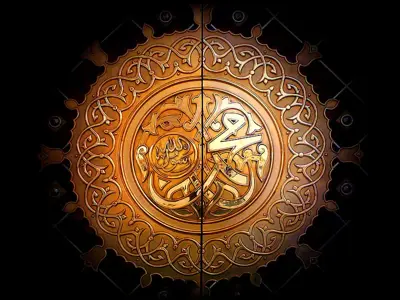
Muhammad was an Arab religious, social, and political leader and the founder of Islam. According to Islamic doctrine, he was a prophet, sent to preach and confirm the monotheistic teachings of Adam, Abraham, Moses, Jesus, and other prophets. He is believed to be the final prophet of God in all the main branches of Islam, though some modern denominations diverge from this belief. Muhammad united Arabia into a single Muslim polity, with the Quran as well as his teachings and practices forming the basis of Islamic religious belief.
