John Wycliffe Quotes
How [the Pope] he durst [dare] make the token [symbol] of Christ on the cross (which is the token of peace, mercy and charity) a banner to lead us to slay Christian men.
The Papacy was at one of it’s lowest points. Two men, Clement and Urban, both claimed the Papacy and each had raised an army to fight the other. Each was promising indulgences to those who would fight, and in a modality similar to the Muslim terrorists of the 21st century, the soldiers were promised ascendancy to Heaven if they fell in battle for such a holy cause. The armies of the popes marched under the cross as their banner, and Wycliffe found that obscene and actually wrote a treatise saying so. See {618087}.
John Wycliffe, ~1324-1384, English religious reformer & Bible translator, Criticism of the Papacy
Sourced by: Eigen's Political and Historical Quotations

Starting with the Crusades, the Popes began giving indulgences to those who would die in battle fighting for a holy cause. The Papacy was then at one of it’s lowest points. Two men, Clement and Urban, both claimed the Papacy and each had raised an army to fight the other. Each was promising indulgences to those who would fight, and in a modality similar to the Muslim terrorists of the 21st century, the soldiers were promised ascendancy to Heaven if the fell in battle for such a holy cause. Wycliffe, in a wonderfully original notion, proposed that the people who live in peace be granted the indulgences. See {618086}.

In the early stages of Islam, Muhammad had hoped to convert the Jews and others on the Arabian Peninsula. When they refused to be converted, he warred against them usually killing the men, and taking the women and children as slaves. The result was that non-believing tribes were “cleansed” from the Arabian Peninsula. The Muslims at the time preferred children as slaves. For then they could convert the children against their will. Adults in Islam must accept Islam in order to convert. Children are regarded as having no such maturity of decision making and therefore opposition to conversion may be ignored and they may be forced. Critics of Islam and those who argue that Islam is at odds with all other religions point to this quotation. They claim that it is the only religion whose founder and fundamental scriptures demand war against others for no other reason than that they believe in a different religion. The Catholic Church during the Crusades and the Inquisition had a similar philosophy as did Christian missionaries colonizing Africa later. One difference is that most Christians today repudiate the doctrine as against the true spirit and teachings of Christ and view it as historical error, while very few modern Muslims repudiate this quotation of the Prophet.


See {582893} for Saladin's Reply. King Richard was the leader of all the Christian forces in the Holy Land for the Crusade. There was a belief, that a wooden cross in the possession of the Muslim force was the true cross of the Crucifixion of Jesus Christ


Different Christian European powers moved in and out of alliances with each other and with the Islamic Ottoman Empire. So Christians were not unified and whenever a Christian country was at war with the Muslims some Christians perceived it as an assault on Christianity—except that there were Christian allies of the Muslims. Later many Muslims would see any conflict with a Christian country as an attack in Islam even when Muslim nations were allied with the Christians as was Turkey at the end of the 20th century. Turkey was a member of NATO and was therefore seen as traitors to Islam by some Muslims. There has always been this tendency to see conflict in terms of religious or ethnic hostility where convenient.
When the Turks defeated the Christians, the only explanation many Christians could conceive of was that God was on the side of the Turks.

Admiral Coligny was a leading French Protestant. He was murdered along with 50,000 Protestants by the French Catholics in what has come to be known as Massacre of Saint Bartholomew. Earlier in his career Pius V had been the an inquisitor or the Inquisition and was appointed “Inquisitor General For All Christendom,” so he had an anti-Protestant background. Incredibly enough, he was beatified and canonized a saint despite—some say because of—his participation in and encouragement murders of non-Catholics and even Catholics who happened to dissent on some aspect of theology. It is not clear whether the Pope knew in advance of the planned massacre or whether he or his representatives had any part in the planning of it. Since the end of the Second World War, Popes have been in the forefront of protest and moral condemnation of religious or ethnic atrocities, and it is hard for most of us to conceive that a Pope could countenance the murder of 50,000 souls by his faithful followers.

Historically, this quotation shows that the negative relationship between the West and Islam and negative views of Islam was not a new phenomenon at the beginning of the 21st century. It existed long before, and as with the 21st century concerns, violence and war were the major concerns.


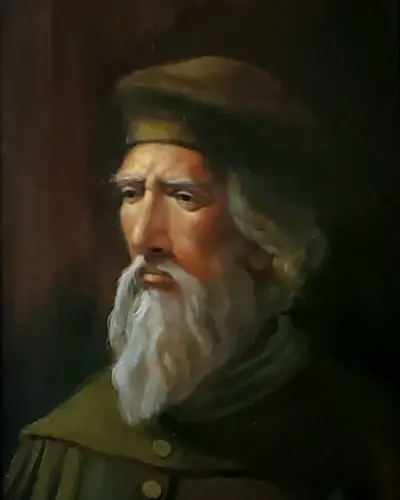
- Born:
- Died: December 31, 1384
- Nationality: English
- Profession: Theologian
John Wycliffe was an English scholastic philosopher, theologian, biblical translator, reformer, priest, and a seminary professor at the University of Oxford. He became an influential dissident within the Roman Catholic priesthood during the 14th century and is considered an important predecessor to Protestantism.
