Ban Ki-moon Quotes
Those responsible are turning schools into military targets and endangering the lives of the children.
Hamas had seized power in a coup of the Gaza Strip, and in July of 2014 they fired thousands of rockets into Israel with a stated aim to kill as many Israeli men, women, and children. The Israelis responded to this act of terrorism and war by a set of air power attacks on the Hamas infrastructure and military targets. They even notified the Gaza population of each target that they before the strike so civilians who might be there could evacuate. Hamas, however, told the people to stay and not to evacuate. They also stored and fired their rockets in civilian institutions like schools and hospitals, thereby turning the institution into a military target according to the Rules of War. United Nations officials observed the Hamas practice in Gaza schools and informed the Secretary General who was furious and made this statement—particularly harsh for a leader of the UN who generally tries to avoid attacking anyone.
Ban Ki-Moon, Secretary General of the United Nations, Statement, July 23, 2014, Quoted on BBC Hardtalk, July 25, 2014
Sourced by: Eigen's Political and Historical Quotations

Hamas had fired thousands of rockets and other missiles at Israeli population centers—war crimes under the Geneva Conventions. Israel finally retaliated against Hamas facilities in Gaza. However, in an unprecedented effort to avoid civilian casualties, the Israeli Defense Forces warned the people by indicating which targets they were going to strike. They also dropped leaflets in Arabic telling the civilians that they are not the targets but to try and avoid harm to them and their families, they should evacuate the neighborhoods that would be under attack. Hamas had placed their missile launchers and other weapons in and near schools, hospitals, mosques and civilian housing risking their civilian population—see {640841}.

The Hamas leadership of the Gaza strip had fired thousands of rockets into Israel which their charter states should be eliminated. The Israelis after many being hit by more than a thousand rockets, used their military to attack (via the air) the Hamas leadership. However, Hamas had stored their rockets and their armaments in or very near civilian facilities including hospitals, schools, mosques and even UN humanitarian facilities. The Hamas leaders thereby made civilian facilities legitimate military targets under the Rules of War of the Geneva and Hague Conventions. So the Gaza leadership, instead of their military protecting their own civilians, used the civilians to protect the military and their weapons in the midst of war. The Secretary General also was referring to the Hamas leadership who had rejected at that point 5 different cease fires that had been proposed by the Egyptians, Americans, The Arab League and others. Israeli accepted them all.


Lawrence of Arabia. In the Middle East, Lawrence led a small Arab army against the Turks and the Germans. In a battle near Tafas, the captured 250 Turkish and German soldiers as prisoners. They them shot them all in cold blood with their Hotchkiss machine gun. What makes this quotation so significant is that one of the great British heroes of WWI was actually guilty of War Crimes. An American journalist gave Lawrence and his exploits great publicity without mentioning the atrocities. The British chain of command also ignored the transgression of one of the most fundamental rules of war even though the clear evidence was in basic battle report files. However, the British never removed the report from the files or destroyed it. The Turks and the Germans while they respected the rules of war with the English, French, and most allies, treated the Arabs much more harshly and murdered Arab prisoners on many occasions. In part this atrocity at Tafas was an act of vengeance and retaliation. But Lawrence never even tried to explain it.


Fundamentalist Muslims, like fundamentalist Jews, believe that all body parts must be buried together and these young Iranian “martyrs” were being blown to bits, thus denying them a proper Islamic burial. This was a problem which the Iranians remedied. What is fascinating about this quotation is that the proper burial was the only perceived problem that needed solving—not the fact that Iran was sacrificing tens of thousands of children to clear minefields with their bodies and certain death. The proprietary of this never received much thought. See {619826} for the leadership perception.

The Abenaki Indians from Canada had come South and raided many of the settlements of upstate New York. In the process, they committed many atrocities killing civilian men, women and children. Amhurst ordered Robert Rogers and his rangers to attack the Abenaki home villiage in Canada on a famous punitive raid. The Rangers, did indeed, raid the Abenaki and wiped out all the males of the tribe that were in the camp at the time. Amhurst hated Indians, but still had his standards regarding the killing of women and children, but was perfectly willing to kill all the mature males. There were no Geneva Conventions at the time. The same general introduced biological warfare by giving Indians smallpox infected blankets. See {619646}


14 years after this statesmanlike speech, Davis flip flopped on this principle and became a firebrand and agitator and hawk for secession and war. It was the Southern upper class that controlled the politics of the South and were the ones who would suffer the greatest economic loss if the Union had continued in the direction of refusing to return runaway slaves and other abolitionist activity. Although many Southerners volunteered to fight for the confederacy, there were not enough and Davis, who in earlier years would not war unless there was genuine demand of the people, for the Civil War, the South had to resort to conscription. The North did as well.


Hamas, a terrorist organization controlling Gaza at that time had fired a thousand missiles into Israel. To stop them, the Israeli Defense Force using air power destroyed hundreds of Hamas facilities and homes of Hamas leaders. They also killed many Hamas terrorists, but at the same time there were also civilian casualties including women and children. Some critics of Israel formulated a moral equivalence between the two sides especially since the Israeli’s had anti-missile defense that exploded most of the missiles in flight. The Israeli Prime Minister explained the moral and ethical distinction. The Israeli’s did not strike any building without warning; they always notified the population in advance as to which target would be hit—something that no other nation had ever done in an armed conflict. However, Hamas forced many civilians to remain in the targeted buildings and almost all of the civilian casualties were to the civilians who Hamas decided to sacrifice. The facilities attacked were all places where Hamas had stored weapons or were command and control facilities, or were used for planning terrorist activities or were the residences of Hamas fighters of high rank. All these are legitimate targets under the rules of war, and the military force that uses them are responsible for clearing the civilians out. In this case, the kept them in, and in many cases sent them in, so that the Israeli military forces would be accused of injuring or killing innocent civilians.


It is easy for those in London to wish for missiles and other weapons to be launched at others. If an Iranian missile were to hit Israel, he would celebrate. Then when the Israeli retaliation strike hits Iran, he will be among the first to call for a cease fire and plead for intervention lest there be bloodshed in Iran. Somehow the Middle East has a disproportionate number of people who are terribly enthused about attacking others without considering the consequence of the retaliation and counter attack.
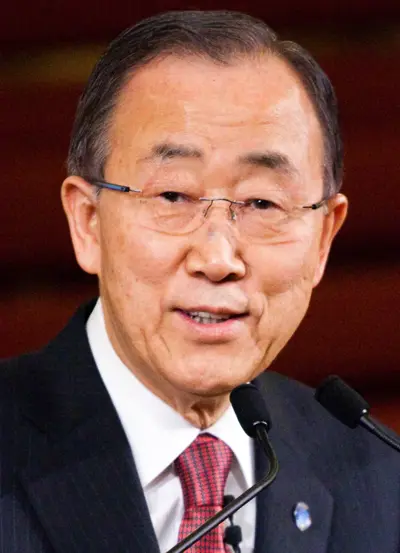
Ban Ki-moon is a South Korean politician and diplomat who served as the eighth Secretary-General of the United Nations from January 2007 to December 2016. Before becoming the Secretary-General, Ban was a career diplomat in South Korea's Ministry of Foreign Affairs and in the United Nations. He entered diplomatic service the year he graduated from university, accepting his first post in New Delhi, India.
