Ettelaat Quotes
In the past we had child-volunteers: 14-, 15-, and 16-year-olds. They went into the minefields. Their eyes saw nothing. Their ears heard nothing. And then, a few moments later, one saw clouds of dust. When the dust had settled again, there was nothing more to be seen of them. Somewhere, widely scattered in the landscape, there lay scraps of burnt flesh and pieces of bone. Such scenes would henceforth be avoided. Before entering the minefields, the children now wrap themselves in blankets and they roll on the ground, so that their body parts stay together after the explosion of the mines and one can carry them to the graves.
Fundamentalist Muslims, like fundamentalist Jews, believe that all body parts must be buried together and these young Iranian “martyrs” were being blown to bits, thus denying them a proper Islamic burial. This was a problem which the Iranians remedied. What is fascinating about this quotation is that the proper burial was the only perceived problem that needed solving—not the fact that Iran was sacrificing tens of thousands of children to clear minefields with their bodies and certain death. The proprietary of this never received much thought. See {619826} for the leadership perception.
Ettelaat, Semi Official Iranian Newspaper, Editorial During the Iran-Iraq War
Sourced by: Eigen's Political and Historical Quotations

The Basiji are an Iranian revolutionary organization of over 10 million young boys who have volunteered to be martyrs. They are led by men over 45 who guide them. Tens of thousands of them died in human wave attacks and mine clearing operations. See {619829}.


Germany had invaded and occupied much of Europe. These two fronts accounted for the majority of the German casualties. The Germans not only violated the Geneva Convention and the Laws of War repeatedly, but as you can see from this quotation, it was deliberate policy. Keitel was tried and hanged after the war. See {621438} .


Hamas had seized power in a coup of the Gaza Strip, and in July of 2014 they fired thousands of rockets into Israel with a stated aim to kill as many Israeli men, women, and children. The Israelis responded to this act of terrorism and war by a set of air power attacks on the Hamas infrastructure and military targets. They even notified the Gaza population of each target that they before the strike so civilians who might be there could evacuate. Hamas, however, told the people to stay and not to evacuate. They also stored and fired their rockets in civilian institutions like schools and hospitals, thereby turning the institution into a military target according to the Rules of War. United Nations officials observed the Hamas practice in Gaza schools and informed the Secretary General who was furious and made this statement—particularly harsh for a leader of the UN who generally tries to avoid attacking anyone.

At the time she was herself in exile in Jordan where she worked with the over 1 million Arab refugees (from both Syria and Iraq) in Jordanian refugee camps. The contrast between the two groups of refugees she found dramatic.

The Wars continued over a decade, costing thousands of American (and Coalition) troops their lives, many more their limbs and mental well-being, with a monetary cost of over trillions of dollars, and the achievements have been few and meager.

This may have been one of the most indelicate and insensitive true public statements ever made by a politician. The English population and their political representatives were angry and worried very much that bombing of cities might become a German pattern (which it did.)

Hamas had fired thousands of rockets and other missiles at Israeli population centers—war crimes under the Geneva Conventions. Israel finally retaliated against Hamas facilities in Gaza. However, in an unprecedented effort to avoid civilian casualties, the Israeli Defense Forces warned the people by indicating which targets they were going to strike. They also dropped leaflets in Arabic telling the civilians that they are not the targets but to try and avoid harm to them and their families, they should evacuate the neighborhoods that would be under attack. Hamas had placed their missile launchers and other weapons in and near schools, hospitals, mosques and civilian housing risking their civilian population—see {640841}.

At this point, the horrors of the German concentration death camps were generally known by the world press. This quotation shows the denial that the Irish Free State was in about the German Nazi atrocities. The 6-county Nationalsits were the Irish counties in Northern Ireland that did not join the Irish Free State and so far as the Catholic Irish were concerned, the Catholics of Northern Ireland were a persecuted minority undergoing oppression and that was not they believed morally different from the murders of millions of Jews, Gypsies and handicapped people in Europe. If the Free State Irish publicly admitted the difference, they would morally have had to join the allies and De Valera was totally opposed to that. Over 70,000 Irishmen and women rejected the moral stand of their government, and volunteered for the British Army to the great distress of the Free State leaders like De Valera. See {639722} for his personal denial of reality.


This would be like an American President firing the congressional chaplains. However this is only one small, but telling, example of Atatuk’s secularization of the nation which had a great deal to do with Turkey becoming a modern great power—by far the strongest and most developed of the Islamic world.


Abu Ghraib was the prison in Iraq where prisoners were brutalized and treated illegally and immorally. Seymour Hirsh was the Pulitzer Prize-winning investigative journalist who broke the story. Levy contrasted that where the Algerian War was full of such atrocities but French intellectuals and press would not publicize it. It didn’t stop for the whole war.

There were other factors which Stalin did not mention. There was a major factor of revenge and retaliation. The Germans had killed 22 million Russians (many murdered deliberately), and forced millions of others into slave labor. They had looted everything of value, artistically or commercially from Russian, homes, churches and other buildings. Many of the Russian officers believed that treatment of the Germans was only just given the barbaric behavior of the Germans and applauded by most of the German population.
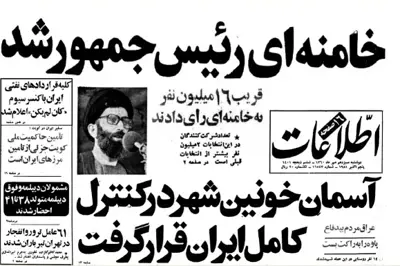
Ettela'at (Persian: اطلاعات, lit. 'Information') is a Persian language daily newspaper published in Iran. It is among the oldest publications in the country, and the oldest running Persian daily newspaper in the world. The paper has a conservative stance and focuses on political, cultural, social and economic news. Until the revolution of 1979, the newspaper was associated with its chief founder Abbas Masoudi (1895-1974).
