Alan Greenspan Quotes
Those of us who have looked to the self-interest of lending institutions to protect shareholders’ equity, myself included, are in a state of shocked disbelief
Greenspan and some others assumed that the shareholders and the executives who ran the financial institutions had the same vested interests. But the executives had disconnected themselves from the fate of the shareholders, by having Golden Parachutes to protect the executives even if the business failed and they were fired. And they got their bonuses immediately so by the time the authorities and the shareholders discovered that the profits the bonuses were paid for were illusory, the bonus money was safely stored in a secret offshore bank. But if things went wrong, there was always the play of getting a government bailout which would keep the executives getting their huge bonuses and keep the shareholders from losing their money as the taxpayers covered most of the losses.
Alan Greenspan, Chairman, Federal Reserve Board, Commenting on the irresponsibility of most of the banks before the Meltdown of 2008, Senate Testimony, October 22, 2008
Sourced by: Eigen's Political and Historical Quotations

Greenspan accepted this as many other economists and financial regulators did. What they did not take into account was the incredible greed of many of the financial executive who were betting with their customers money, If the bet was right they, the shareholders and the customers all made out very well as they were highly leveraged. If the bet was wrong, the shareholders and customers lost a lot, and the financial executives only made their multimillion dollar salaries and bonuses (Many were actually were guaranteed their bonuses even if they put the company into bankruptcy.) Worse, they earned their money when they made their sales or earnings targets, but when the securities they bought went sour, even if the company had no funds left, the. It was “heads we all win and tails only I win.” The vested interests between the financial company executives, the shareholders, and the clients were divergent, and the customer was at the bottom of the money pole.


While Stockman and some others believe that the Meltdown of 2008 would have “run its course” if the government didn’t bail out financial institutions, the very conservative Republican Secretary of the Treasure Paulson and the Chairman of the Federal Reserve told President Bush, Congress, and incoming President Obama that if there was not a quick bailout, the economy of the nation would crash with a depression resulting as bad if not worse of the Hoover Depression of 1929. Bush and Obama and the majority of Congress agreed and took action to avoid that. There is no way of knowing whether they were right or Stockman was. However, the people with the responsibility of governing and safeguarding the nation clearly did not want to take a chance that the advocates of no action might be wrong.

This warning was a decade before the Meltdown of 2008, but was not heeded by any of the politicians. As a result a number of the companies that made all those risky decisions assumed that if something went terribly wrong the government would not let them fail. Unfortunately, they were right and the taxpayers spent billions to prevent companies from failing. After the meltdown all the politicians vowed to end the too big to fail concept, but while some improvements were made, the Congress could not come to agreement, and the markets and a number of companies think that they are still too big to fail. This is particularly true for Defense Contractors where the government has and probably will in the future, protect irresponsible companies from failure if they are the only company that makes needed weapons and other equipment.


High level financial industry executives were earnings millions of dollars even if the company did poorly. In many cases annual bonuses were paid even after the firm lost money and in some cases after the firm had to be sold to stave off bankruptcy. The worst thing in 2009 and 2010 was when some of the banks paid million dollar and more bonuses while the company was getting bailout money from the taxpayers to prevent their bankruptcy.

Corporations were not common at the time. The corporations of the day like large corporations today had directors and managers who were not the principle owners. There was deep suspicion that these professional managers would not watch over the money of the corporation with the same degree of vigilance as would the owner manager. The same problem exists today when the economic vested interest of the managers and the shareholders do not always coincide. Various bonus schemes have been created to ameliorate the problem, but as the meltdown of 2008 and the Great Recession demonstrated, many managers would make ruinous decisions for the corporation as they could get large bonuses. “Copartnery” is an older English term for “partnership.”

The savings and loan crises became clear shortly thereafter.

He was replying to Senator Grassley--{637990}. This quotation is one of the saddest admissions in American law enforcement and corporate regulatory history. A small group of very wealthy men, working for huge financial corporations caused the worst financial crisis since the Great Depression. The Government regulators were reined in by the Bush Presidential administration and were none to competent anyway. The Clinton Administration repealed the Glass Stiegel Act allowing banks to gamble with customer’s The Congress made matters worse by kowtowing to the housing and real estate special interests and overheating the housing market. But with all that some of the many of the financial executives committed crimes ranging from financial fraud to forgery of court documents. But they had put the country into such a poor economic state, that the Obama administration feared that prosecution of some of the leading financial executive criminals would spook the financial markets and cause an even greater economic situation. At least the Attorney General admitted the truth of Senator Grassley’s suspicion--{637990}.


The result was regulation of the banks and the creation of the SEC to regulate the stock market, However, over the years, the regulations were not able to keep up with the sophisticated development of new forms of investments and financial instruments and the financial industry were able to speculate with other people’s money in ways that FDR and his reformers never imagined. Finally, even the regulation that did exist was weakened by the policies of the George W. Bush administration and the combination brought about the Great Recession of 2008 where the profits from excess speculation were privatized and the losses, socialized with the taxpayer and the American worker bearing the brunt while most of the speculators were bailed out and made more money than ever. The Obama administration tried to reform the situation, but was unable to put an end to the legal speculation with other people’s money or of having institutions that were “too big to fail.”


Banks often lie. The system encourages them to do so. In a crisis, if a bank honestly says that it is not sure that it has enough cash and other liquid assets, others will not lend it any more money and depositors will rush to withdraw their money, thereby almost insuring a failure. The bank that lies, might weather the storm and survive.
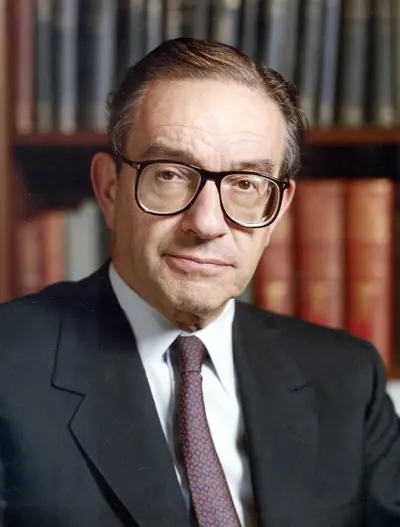
Alan Greenspan is an American economist who served five terms as the 13th Chair of the Federal Reserve of the United States from 1987 to 2006. He works as a private adviser and provides consulting for firms through his company, Greenspan Associates LLC. First appointed Federal Reserve chairman by President Ronald Reagan in August 1987, he was reappointed at successive four-year intervals until retiring on January 31, 2006, after the second-longest tenure in the position (behind William McChesney Martin).
