Janet Yellen Quotes
For my own part, I did not see and did not appreciate what the risks were with securitization, the credit ratings agencies, the shadow banking system, the S.I.V.’s — I didn’t see any of that coming until it happened.
Yellen, Janet L. Interview. Financial Crisis Inquiry Commission, 2010.

She had warned about the unregulated derivatives 10 years earlier, but to no avail. See {637987}. Then when she had been proven prescient in the Meltdown of 2008, Congress was more interested in how she thought they could prevent future problems with derivatives. Some were adopted but not all. The financial institutions claimed that they needed derivatives to hedge positions and hence “stabilize” the system. Of the members of Congress who voted on this issue, almost none understood derivatives and credit default swaps were and how they worked. But some were sure they were bad, and others were sure that they were necessary for stability. Derivatives can, and did, get so complicated that the people who originally created them sometimes cannot tell whether they are at risk or not. Even computer cannot calculate the value and risks of these instruments because the values and risks depend on what happens to other companies or instruments which themselves have derivatives insuring them. See {620038} for a good description of the difficulty.


Sovereign credit substitution is where the government, one way or another, assumes and guarantees the debts of private corporations. This is an elegant way of saying: “taxpayer bailouts”

Moody’s and Standard & Poors, the 2 largest credit rating agencies, gave A ratings to securities that had packaged terrible F-rated, toxic, subprime mortgages, and gotten the credit ratings agencies to rate them as A on the theory that the risk was diversified. Each new security like this that a bank put out was submitted informally to one of the credit rating agencies to “discuss”. If the agency “concluded” that they could give it an A rating, they received a very large fee. If not, the bank would not officially submit the security and not pay anything. That almost never happened with these packages of subprime mortgages.

U. S. Treasury Secretary Larry Summers called Rajan a “Luddite” for this view, but what Rajan observed and predicted was exactly what happened in the Meltdown of 2008 which led to the Great Recession. Rajan was one of the few economists to call this right. Several, invested their own money assuming a crash and made billions. Most, like Summers and the Federal Reserve Chairmen in retrospect admitted that they missed the signs and didn’t connect the dots. See {637168}, {637987}, and {620038}

Greenspan and some others assumed that the shareholders and the executives who ran the financial institutions had the same vested interests. But the executives had disconnected themselves from the fate of the shareholders, by having Golden Parachutes to protect the executives even if the business failed and they were fired. And they got their bonuses immediately so by the time the authorities and the shareholders discovered that the profits the bonuses were paid for were illusory, the bonus money was safely stored in a secret offshore bank. But if things went wrong, there was always the play of getting a government bailout which would keep the executives getting their huge bonuses and keep the shareholders from losing their money as the taxpayers covered most of the losses.


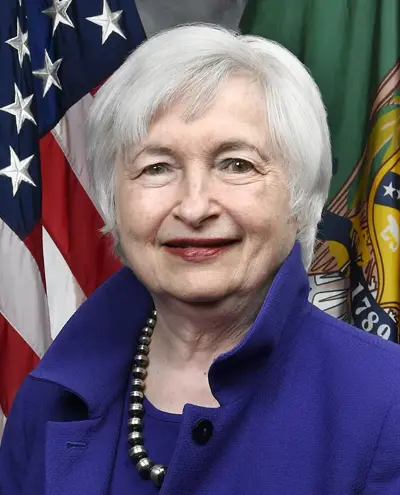
Janet Louise Yellen is an American economist, civil servant and policymaker serving as the United States secretary of the treasury since January 26, 2021. A member of the Democratic Party, she previously served as the 15th chair of the Federal Reserve from 2014 to 2018. She is the first woman to hold either role. She is also a professor emerita at Haas School of Business at the University of California, Berkeley, and formerly a distinguished fellow in residence at the Brookings Institution.
