Joseph Stiglitz Quotes
I view the [credit] ratings agencies as one of the key culprits. They were the party that performed the alchemy that converted the securities from F-rated to A-rated. The banks could not have done what they did without the complicity of the ratings agencies.
Moody’s and Standard & Poors, the 2 largest credit rating agencies, gave A ratings to securities that had packaged terrible F-rated, toxic, subprime mortgages, and gotten the credit ratings agencies to rate them as A on the theory that the risk was diversified. Each new security like this that a bank put out was submitted informally to one of the credit rating agencies to “discuss”. If the agency “concluded” that they could give it an A rating, they received a very large fee. If not, the bank would not officially submit the security and not pay anything. That almost never happened with these packages of subprime mortgages.
Joseph Stiglitz, Chairman, President's Council of Economic Advisors, Referring to the factors in the Meltdown of 2008 causing the Great Recession, Quoted in Barry Ritholtz, Bailout Nation, 2009
Sourced by: Eigen's Political and Historical Quotations


Between the politicians and the financial industry lobbyists the laws are written so that there is sufficient room for enough self dealing so that members of Congress can get rich using methods that are questionable but have been legislated as legal and the Congressional rules have been written so that they are “not unethical”. Many members of Congress leave the institution much wealthier than when they entered but have received salaries that are insufficient to build that kind of wealth. Many then accept lobbying or other jobs at very high pay representing the people and corporations who have been the subjects of their legislative efforts. Other members do not avail themselves of the “legal” self dealing as the practice is not universal.

Sovereign credit substitution is where the government, one way or another, assumes and guarantees the debts of private corporations. This is an elegant way of saying: “taxpayer bailouts”


In the Savings & Loan crises there were under 1000 bankers and others who had committed crimes, In the Meltdown of 2008, there were tens of thousands of criminals. Almost everyone connected with home mortgages broke the law, and all of the major banks in America had officers at the highest levels who committed perjury and fraud regarding foreclosure of mortgages. The biggest fish were involved as well as many thousands of others. Wall Street and the financial industry spend many millions in lobbying and campaign donations to be sure that there would be very few prosecutions and even then no major financial leaders would be called to account in a criminal court. The FBI had identified MILLIONS of cases of perjury and fraud in bank forclosures alone.


U. S. Treasury Secretary Larry Summers called Rajan a “Luddite” for this view, but what Rajan observed and predicted was exactly what happened in the Meltdown of 2008 which led to the Great Recession. Rajan was one of the few economists to call this right. Several, invested their own money assuming a crash and made billions. Most, like Summers and the Federal Reserve Chairmen in retrospect admitted that they missed the signs and didn’t connect the dots. See {637168}, {637987}, and {620038}
Geithner, the Treasury Secretary immediately after the Meltdown of 2008, facing complete collapse of our financial system, among other ameliorations, advocated and implemented many subsidies to bail out the banks most of whom had been greedy, foolish and often dishonest. He even allowed banks to use taxpayer money to pay bonuses to Bank executives who had brought the bank to ruin being a cause of the crisis. However, the banks not only survived but recovered and made huge profits while many of the taxpayers whose funds were used to help the banks were still struggling to make ends meet and it was they who received little, if any, government assistant.

At this time it was 6 years after the Home Financing Crisis and the Meltdown of 2008 and despite tens of thousands of law violations by the bank, the Justice Department was finally finishing their investigations and requiring some penalties. Other negotiations with other banks were in progress, but no bank executives were going to jail for the millions they handled fraudulently, whereas a burglar who stole household goods would do jail time.

When the Meltdown hit America, the crisis drew attention to the fiscal solvency and stability of banks in most of the world. The Irish banks were much more overextended than those of most counties and when that came to light there was a bank panic in Ireland. Ahern and the Irish Dail (parliament) decided to bail out the Irish bank at a very great cost to the rest of the Irish economy and people. He believed if Lehman Brothers had been bailed out, as America did with other institutions, the Irish bank bubble would not have burst. It is not known whether he actually meant to use the word “testicles” or he made a gaff intending to use the word “tentacles”. Both have relevant meaning in the situation with a significant shade of difference in meaning between the two.

This was a very important quotation because Cox was a strong advocate of deregulation and voluntary regulation, and that is why he was appointed to head the SEC by George W. Bush. He was the leading Republican expert on Regulation of the Stock Markets and sale of public securities. However when the Meltdown of 2008 hit, it was clear to all but the extreme ideologues that some Federal regulation was necessary. Nonetheless, it took several years to reform the regulations for the financial industry with the Banks and Wall Street fighting it all the way and by that time the Republican Party had been so dominated by ideological conservatives that the views of Cox and others no longer had much influence. They fought the Dodd-Frank reforms to go preserve self regulation to a great extent.

Greenspan and some others assumed that the shareholders and the executives who ran the financial institutions had the same vested interests. But the executives had disconnected themselves from the fate of the shareholders, by having Golden Parachutes to protect the executives even if the business failed and they were fired. And they got their bonuses immediately so by the time the authorities and the shareholders discovered that the profits the bonuses were paid for were illusory, the bonus money was safely stored in a secret offshore bank. But if things went wrong, there was always the play of getting a government bailout which would keep the executives getting their huge bonuses and keep the shareholders from losing their money as the taxpayers covered most of the losses.

Born thought that her agency was responsible for regulating the new esoteric financial products—derivatives including credit default swaps—for otherwise there would be no regulation at all of financial products that could dwarf the stock and bond market. Summers persuaded her to back off. When the Meltdown of 2008 hit, the huge derivative exposure of the large banks and some insurance companies was so great that it was one of the major causes for the meltdown of the entire banking system. Summers, normally a great economist not only called this one wrong, but later, along with most other government and private economists ignored a very explicit warning—See {637168}, {637986}, and {620038}.
The President, like most Americans, was outraged at the immoral, insensitive, and incompetent behavior of the financial industry in the Meltdown of 2008. However, the President learned how dependent the economy of the entire country was dependent on having solvent banks and how vulnerable the entire nation was to major failures of the investment and regular banks. So he was faced with very poor options. The government could have nationalized the banks, but that would produce an economic system which in the long run would not be very sound. Of the banks could be allowed to fail or risk failure in which case the entire population would suffer. Or he could lend money to the banks to stabilize and strengthen them while the bank executives were paying themselves huge bonuses even though they performed so poorly. He chose the latter and Warren was typical of criticism he received from many of his supporters. Even though the banks had broken the law and forged documents and committed perjury in tens of thousands of mortgage foreclosures, the President, as a practical matter, could not even prosecute the bank officials who were responsible because there were thousands of bank and other company officials who had committed the same crime. The guilty included almost every senior officer of the major banks, and jailing all these people was deemed impractical. So, to recover the economy, justice and fairness suffered.
All three of the credit rating agencies gave securities of bundled very risky mortgages the highest and most secure ratings. They never examined the underlying securities, and continued to give these AAA ratings even after many had defaulted and they were in “junk bond” status. The rules then were that the financial companies who wanted a rating would “discuss” the rating that they would get BEFORE they paid the rating companies to do the rating. In no case did they ever pay a rating agency for a rating unless there would be a AAA rating despite the fact that these securities were among the highest risk public securities in American financial history. Under the law at the time, the rating agencies could not be held liable for there irrational ratings.

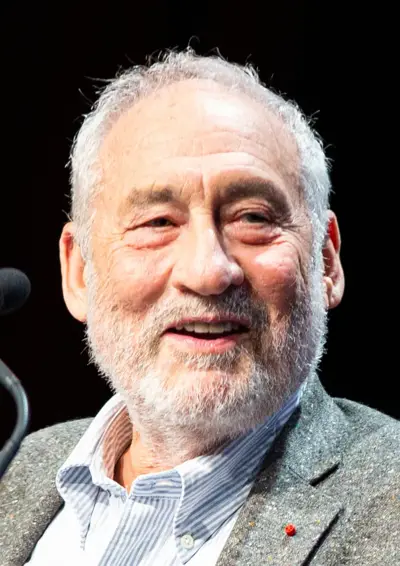
Joseph Eugene Stiglitz is an American economist, public policy analyst, and a professor at Columbia University. He is a recipient of the Nobel Memorial Prize in Economic Sciences (2001) and the John Bates Clark Medal (1979). He is a former senior vice president and chief economist of the World Bank and is a former member and chairman of the (US president's) Council of Economic Advisers. He is known for his support of Georgist public finance theory and for his critical view of the management of globalization, of laissez-faire economists (whom he calls "free-market fundamentalists"), and of international institutions such as the International Monetary Fund and the World Bank.
