Adam Smith Quotes
Corporate trading is vicious in principle. The directors of such companies, being the managers rather of other people's money than of their own, it cannot well be expected that they should watch over it with the same anxious vigilance with which the partners in a private copartnery frequently watch over their own … Negligence and profusion must always prevail, more or less, in the management of the affairs of such a company
Corporations were not common at the time. The corporations of the day like large corporations today had directors and managers who were not the principle owners. There was deep suspicion that these professional managers would not watch over the money of the corporation with the same degree of vigilance as would the owner manager. The same problem exists today when the economic vested interest of the managers and the shareholders do not always coincide. Various bonus schemes have been created to ameliorate the problem, but as the meltdown of 2008 and the Great Recession demonstrated, many managers would make ruinous decisions for the corporation as they could get large bonuses. “Copartnery” is an older English term for “partnership.”
Adam Smith, 1723-1790, Scottish Political Economist, The Wealth of Nations, 1776
Sourced by: Eigen's Political and Historical Quotations

Greenspan and some others assumed that the shareholders and the executives who ran the financial institutions had the same vested interests. But the executives had disconnected themselves from the fate of the shareholders, by having Golden Parachutes to protect the executives even if the business failed and they were fired. And they got their bonuses immediately so by the time the authorities and the shareholders discovered that the profits the bonuses were paid for were illusory, the bonus money was safely stored in a secret offshore bank. But if things went wrong, there was always the play of getting a government bailout which would keep the executives getting their huge bonuses and keep the shareholders from losing their money as the taxpayers covered most of the losses.


That has been the average perception well into the 21st century.

See {586119} for an earlier English version of this point.

The huge salaries paid to CEO’s in the early 21st century became a major political issue during the George W. Bush administration in the wake of the Corporate scandals like Enron and the failure of the Government to prevent these frauds. The tax deductibility of the huge salaries also attracted political attention at a time when Bush policies had created the largest deficits in the history of the world.

Like politicians, business CEOs almost always blame others lower down in the chain for their errors. (Politicians usually blame someone from the opposition of the opposition as a group.)


After Congressional hearings showing that the insurance guarantee funds were ripe with conflict of interest and industry control:

Corporate CEO pay had traditionally been 5-15 times the average wage for the company. But it had changed to where in banks and financial companies the CEO pay was often 100-1000 times the average salary. This became a major political issue after the 2008 Meltdown. During the Great Recession some CEOs who had led the company to huge losses and then had to take government money to bail them out and prevent bankruptcy, took multimillion dollar salaries and huge bonuses while average salaries had gone down. There was a move for government to regulate CEO salaries. Macke argued for the position that would finally be taken.

High level financial industry executives were earnings millions of dollars even if the company did poorly. In many cases annual bonuses were paid even after the firm lost money and in some cases after the firm had to be sold to stave off bankruptcy. The worst thing in 2009 and 2010 was when some of the banks paid million dollar and more bonuses while the company was getting bailout money from the taxpayers to prevent their bankruptcy.

Note the difference in standards that existed at the beginning of the 20th century. The Wall Street Journal was offended because corporations had paid agents in labor unions, legislatures and political parties. A century later it was common for corporations to have many lobbyists (overt and covert) in legislatures,. They had key representatives in political parties and gave the parties huge fiscal and service contributions and not only had their paid agents in labor unions but often sometimes paid the officers of the unions. The morality of 1904 seems almost quaint.


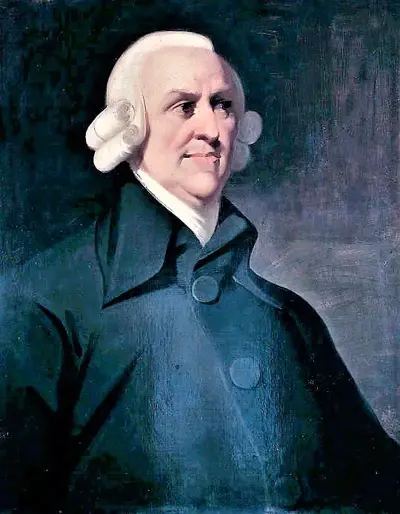
Adam Smith FRSA was a Scottish economist, philosopher as well as a moral philosopher, a pioneer of political economy, and a key figure during the Scottish Enlightenment, also known as ''The Father of Economics'' or ''The Father of Capitalism''. Smith wrote two classic works, The Theory of Moral Sentiments (1759) and An Inquiry into the Nature and Causes of the Wealth of Nations (1776). The latter, often abbreviated as The Wealth of Nations, is considered his magnum opus and the first modern work of economics. In his work, Adam Smith introduced his theory of absolute advantage.
