Maria W. Stewart Quotes
This is the land of freedom. The press is at liberty. Every man has a right to express his opinion. Many thinks, because your skins are tinged with a sable hue, that you are an inferior race of beings; but God does not consider you as such. He hath formed and fashioned you in his own glorious image, and hath bestowed upon you reason and strong powers of intellect. He hath made you to have dominion over the beasts of the field, the fowls of the air, and the fish of the sea. He hath crowned you with glory and honor; hath made you but a little lower than the angels; and, according to the Constitution of these United States, he hath made all men free and equal …. It is not the color of the skin that makes the man, but it is the principles formed within the soul.
Maria W. Stewart, 1803-1879, Writer, Journalist and Abolitionist, “Religion And The Pure Principles Of Morality, The Sure Foundation On Which We Must Build,” 1835
Sourced by: Eigen's Political and Historical Quotations


1st Earl of Mansfield


This quotation many think is the greatest statement of political equality ever written. Interestingly is also lays an obligation on all people for all others. It was written by a privileged nobleman, a Baron, who was instrumental philosophically and politically in establishing the Batavia Republic in Holland.

This was the first major civil rights speech. He had previously in his political career tread carefully in the civil rights arena. The Southerners had disproportionate control over the Congressional committee chairmanships and they could hold up his entire legislative agenda. JFK’s father was a right wing fascist who supported Hitler earlier and always advised against pushing civil rights.

This quotation illustrates a huge difference between Roman Slavery (as well as slavery in many other societies) on the one hand and American Slavery which was much more pernicious. In Rome, slave and master status was a function of circumstances—events and luck. The slave was inherently no less able than the master. Indeed, if a battle might have gone the other way, their roles could be reversed. There was huge inequality of rights and privileges, between slaves and masters, but inherently they were both humans. Often slaves as a result of life before capture were very educated—far more so than their masters. Some were leaders, some poets. In American Slavery there was an overlay of inherent inferiority which most Southerners believed, and worst of all, the perpetuation of that notion tended to be believed by most American slaves. The American slave never had the human dignity that a Roman slave did.
The power structure of England and the English administrators of South Africa were strong advocates of racial equality at the beginning of the 19th century. They insisted on equal administration of law. However the Boer white population could think of nothing more absurd. In a sense the Boers were much like the Southern Whites at the same time. The South African government however could not enforce its equality policies in the rural area – the majority of South Africa at the time. When democracy and self rule came to South Africa, the racially moderating force of the English was minimized and the majority of South Africans wanted a racially segregated society. Apartheid resulted.


This is a particularly memorable quotation for several reasons. First the address was given by a young senior student who would later be a member of Congress, a effective abolitionist, and the author of various pieces of legislation that vexed the South. What is even more memorable is that the oration was given at an Ivy League College Official Graduation. The Ivy league schools, despite their reputation for intellectual freedom, generally were very adverse to any discussion about the slavery issue as it would cause too much passionate contention. See {621346} for an example at Harvard. In addition, Brown University was in Providence RI, where the economy depended in substantial part on slavery. The Co-Founder of Brown was himself a slave trader {622028}. This was one of the early American anti-slavery orations.


Earlier {629154} Smith was much more sympathetic with slavery. His views evolved as you can see by the comparison. He stated that he had a vision and made two prophesies {629156} that indeed came true. The last idea of slave buyouts seemed plausible to many abolitionists initially when they were not really knowledgeable about the economics of slavery. However, once they studied it, it became clear what it would not work even if the Southerners would then be willing to accept Blacks as free laborers which most were not, The two biggest problems were: 1) the international slave trade had been abolished. The only source of new slaves for growth was breeding them. Therefore, having slaves had TWO economic values—the work that they could do and the reproduction of themselves. A critical mass of owned slaves produced an income forever. And for Southerners who were culturally adverse to work (see {629169}), just having cash for their slaves was not enough. They were the servants, the farm labor, and their recreational sex. 2) and most important, the value or the slaves of the South was greater than the economic value of all the land, all the farms, all the buildings, all the factories, and all the inventory of the stores of the South all put together. The Southern slaves were the majority of the wealth of the south. There was no asset that could ever produce enough value to pay for the slaves—even over time. It would be like trying to buy all the shares of all the corporations in America today. There is no asset big enough to raise the money to ever finance it. The idea may have worked in Colonial America or even prior to the outlaw of the international slave trade, but by the time anyone took the idea seriously it was economically no longer feasible.

Although Wedgwood was a business man and ceramic manufacturer, he was a staunch abolitionist. He made these medallions by the thousands and gave them to all who would receive them. The text became the motto of the anti-slavery society. It was one of the first examples of a logo – a symbol for a political cause being very effective.

This was the first success that the anti-slavery forces of England had—the recognition and official classification of slaves as humans. After that, it was easier to abolish the slave trade which occurred 16 years thereafter.


This remarkable statement was written in about 1840 and there was probably then few people of either gender who would think such a thing possible.

Douglas was appealing to the racist crowd in Galesburg by showing that Lincoln actually believed in Racial Equality. This technique was used be racist politicians—since then and in a few places of the South even into the 21st century.


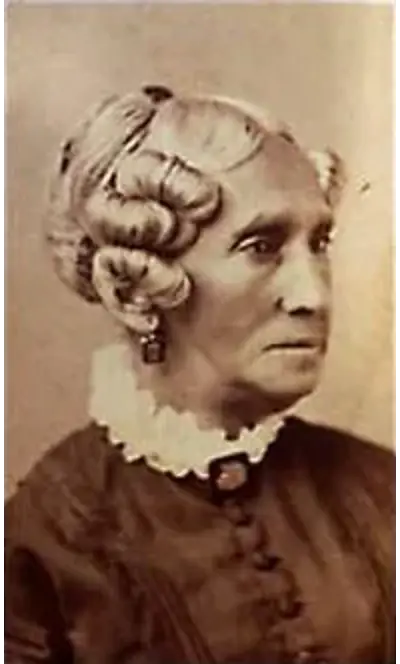
Maria W. Stewart (née Miller) was a free-born African American who became a teacher, journalist, lecturer, abolitionist, and women's rights activist. The first known American woman to speak to a mixed audience of men and women, white and black, she was also the first African-American woman to make public lectures, as well as to lecture about women's rights and make a public anti-slavery speech.
