Tacitus Quotes
They have plundered the world, stripping naked the land in their hunger… they are driven by greed, if their enemy be rich; by ambition, if poor… They ravage, they slaughter, they seize by false pretenses, and all of this they hail as the construction of empire. And when in their wake nothing remains but a desert, they call that peace.
Tacitus, Cornelius. The Agricola and Germania. Translated by Alfred John Church and William Jackson Brodribb, Macmillan and Co., 1877, p. 22.


While he fairly described the Spanish intentions, the reality which was not known at the time, was that most of the deaths in South America were caused by disease brought by the Spanish for which Europeans had some immunities and the natives of the New Word, none.

See {633119} for the basic provision of the Dawes Act.


This quotation distressed many ultra rightists who otherwise were avid followers of Mises. See {632407} for another quotation that distressed many European conservative devotees of Mises.


He was contrasting the English efforts in the New World and the French. New France was the term for the early French North American areas much of which was in Canada. This classic view argues for the superiority of a capitalistic and individualistic development model over a planned one organized from the top down,

this is a joke Tutu has used, but variants of it exist which are not original to him.


Genocide generally means the intentional destruction and elimination of a people. In the case of Columbus and the Spanish Conquistadors, they thought little of the lives of the indigenous people of the New World, but they wanted them for slaves to extract the gold and silver. They wiped out several peoples, mostly as a result of the communicable diseases (mainly smallpox) they brought from Europe for which the South Americans had little or no immunity. Also the size of the invasion forces (the Spanish) was relatively small. The size in land and number of people who they invaded was huge. The Spanish were the worst of the European empires from the point of view of the native colonized people. And Columbus was the trigger. So Chavez has a point in castigating Columbus and the Spanish but, typically, and like many politicians, his oratory lacked the precision of total accuracy.


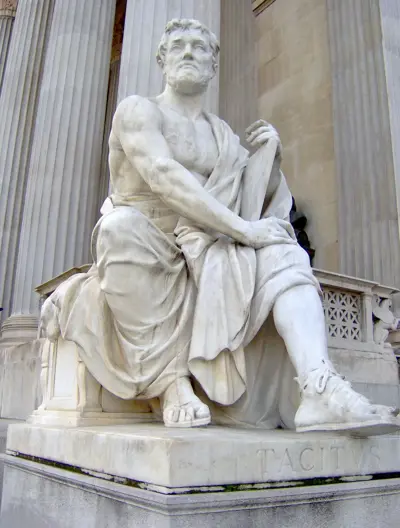
Publius (or Gaius) Cornelius Tacitus (AD 56 – c. 120) was a Roman historian and politician. Tacitus is widely regarded as one of the greatest Roman historians by modern scholars. He lived in what has been called the Silver Age of Latin literature, and has a reputation for the brevity and compactness of his Latin prose, as well as for his penetrating insights into the psychology of power politics.
