Thomas Brightman Quotes
There Saracens were the first group of locusts … about the year 630. They were succeeded by the [Ottoman] Turks, a brood of vipers worse than their parent, who did utterly destroy their mother, the Saracens.
Thomas Brightman, 1562–1607, English Clergyman & Writer, Example of Christian Islamophobia and Prejudice, 1644
Sourced by: Eigen's Political and Historical Quotations

Ottoman Turkish Sultan Mehmed II Aeneas Sylvius Piccolomini. 6 years earlier, the Ottoman Turks, had captured Byzantium (Constantinople, later Istanbul), the capital of the Eastern Roman Empire. The Pope had called together the rulers and leaders of Christendom to organize a common defense in this war of civilizations. This was the period where Christian Islamophobia began. The Muslims had a religious duty to convert the rest of the world to Islam and adopt Islamic law (Sharia). However, so did the Christians. Sultan Mehmed II, when he conquered Byzantium, did not require the conversion of the Christians in the great city. He took the greatest churches, but by and large left the Christians to worship in their own Churches. The Muslims at the time were far more tolerant of Christians (and Jews) than the Christians were of Muslims (and Jews). Like in the 21st century, there was much Islamic doctrine and reality to be worried about, but not all the Muslims were as rabid and extreme as Eastern paranoia suggested in the 15th century or the 21st.

A large part of the Middle East and the now “Arab” states used to be a very large Jewish State. Jews had lived in the Palestinian area and expanded from there, also using conquest as all other nations had and even occasionally, forced conversion, to establish the Jewish State. This was destroyed by the Romans and the Jews have not had a state until 1948 when the UN voted to create Israel.


The Turkish Ottoman Empire controlled most of the Middle East and at times Arab areas and tribes would revolt. Egypt was considered the prize of the Middle East. The Ottomans not only controlled the Middle East militarily and civilly, but also religiously. The Turkish Sultan was the spiritual leader of almost all of the Middle Eastern Muslims.

The Ottoman Turks had just conquered the city of Constantinople including the Eastern Roman Empire in their domain. They would be the dominant power in the area until the First World War when they made the mistake of siding with the Germans and the Ottoman Empire was broken up in the Treaty of Versailles.

The Byzantine emissary had pointed out that Mehmed’s predecessors had signed a treaty agreeing to “consult” with Constantinople before building any fortified structure in the area surrounding Constantinople. Mehmed was only 19 years old at this time. His intention f building a fort was to have a platform from which to attack and capture Constantinople itself which he did 2 years later. Earlier, the Eastern Roman Empire was much stronger and the Ottoman sultans were more cautious in dealing with them. However, the various Christian factions were all feuding with each other, and Mehmed II, despite his youth, was much better organized and was a better leader than his predecessors.


In the Asymmetric Warfare the insurgent “wins” a battle by surviving even if the insurgent takes massive casualties. As long as some exist—they can recruit and expand.

This quotation illustrates that the Muslim conquest and attempt to destroy and desecrate the symbols of other religions was not limited to Christianity—it was ALL other religions. In that sense, Christianity and Islam of the period were very similar at the time—intolerance to the point of murder and destruction of any “heathen” religion.


The American Revolution was being debated, and few saw the long range implications of the independence of America. Fox was one who did.

This particular quotation is very important. Khomeini was probably the most influential Muslim in the 20th Century. The fact that he wrote this in 1942—before there was an Israel as an enemy—shows how deep seated the requirement for world conquest is. To the Nazi’s world conquest was a justifiable goal. To Khomeini and his many followers, it is a religious obligation and duty and thus is every more dangerous. Extreme anti Muslims justify the attempted expulsion of Muslim immigrants on the grounds that they are a fifth column whose loyalty is and will be to the religion which will attempt to conquer their country. It gives Islamaphobia a veneer of respectability.
a political party. In the early days of the Muslim religion, the entire Middle East was under the authority of the Caliph who had both religious and civil authority—very much like the Pope did in Europe. However, corruption, independent tribes, feuds, and civil wars destroyed the Caliphate and there has been no common Islamic leader since. Some Muslims want to eradicate the individual countries and restore the Caliphate.
Aeneas Sylvius Piccolomini. 6 years earlier, the Ottoman Turks, had captured Byzantium (Constantinople, later Istanbul), the capital of the Eastern Roman Empire. One o the reasons the city fell was the squabbling of the different Christian national armies about support for the city and the internal bickering of those armies and navies that were there. The Emperor, Constantine XI, the successor to Constantine the Great—the roman Emperor who Christianized the Empire, was killed. Emperor Justinian had built the Hagia Sophia—the largest church at the time and for 1000 years thereafter under a single dome, and this great house of Christianity was turned into a Mosque by the Islamic conquerors.

The “Caliphate” is the Islamic concept of a single leader of all Muslims in the world who has both Religious and Political power at the same time. After the death of the Prophet Mohammed, there were a succession of Caliphs and Baghdad was considered the seat of the Caliphate for much of that time. For fanatic Muslims who want to bring back the Caliphate, Baghdad has an importance that is almost on a par with Mecca and Jerusalem. The George W, Bush administration did not recognize the importance of Baghdad and Iraq to non-Iraqi Muslims and the importance of driving infidels (Christians) our of their “seat of government,” This was one of the motivations that brought so many “foreign fighters” into Iraq who would not stop at anything in order to get the infidels out.

Almost all former colonial nations resent the colonialism and tend to overlook some of the benefits. Like European colonialism, the Ottoman Empire brought many benefits and advancements to their subject peoples but the oppression is what is most remembered by future generations. Despite the terrible history of the Ottoman Empire in the Armenian Genocide and some other massacres, the Ottoman Empire had more than a 500 year influence on a great part of the world�Islamic and Christian – much of which was very valuable to the world even today.

Greece had always coveted Anatolia which was a part of the Ottoman Empire but had been in antiquity a Greek dominated area. Further, people of Greek ethnicity and culture, who hundreds of years ago use to be the vast majority were after the hundreds of years of Ottoman rule and migration were then the largest minority in Anatolia. After the Turks lost the First World War as a consequence of their allying with Germany, and had been stripped of its Arab territories and was determined to keep the territories that they still had. Also, Turkey had just undergone a revolution and the old order was displaced. Venizelos and the Greeks saw this as an opportunity to get back Anatolia and sent a military invasion force to land at Smyrna (Ismir to the Turks), the largest city of Anatolia where despite the Greek minority in all of Anatolia, Greeks were a small majority in Smyrna and many of the ethnic Greeks not only aided the Greeks once they had landed but participated in atrocities against the minority of Turkish Muslims of Smyrna. The Ambassador was then trying to rationalize the heavy hand with which the Turks dealt with the indigenous Greeks many of whom were guilty and many of whom were not.

He is a Greek Orthodox Christian, and he correctly observes that the Islamic world was considerably more tolerant than the Christian until the 18th century when Islam had become less tolerant in the Middle East while the Christians were modernizing and going through a cultural and intellectual enlightenment and societal modernization while the Muslims, became less tolerant than they were in earlier years leading to the modern situation.


The source was in the form of an autobiography but was written later by someone unknown. Prior to WWII and the German killing of over 25 million people, Tamerlane was responsible for more killings than any other ruler in the world. 17 million is generally given as the number if one analyses the Persian, Indian and other literature. He controlled the Middle East, the Ottoman States, a part of Russia and Eastern Europe, Persia and much of China and India. Although he himself was a Muslim he warred against other Muslim states and warlords defeating them all. Muslim nations are historically very ambivalent about Tamerlane. Pride as a conqueror is eclipsed by this excessive rapine and murder. In one case, the Persian city of Isfahan, he actually built a giant pyramid of 70,000 decapitated heads of prisoners. Also, the fact that he attacked and defeated major Muslim empires violates a current Muslim notion that there is a unity of Islam. He attacked, conquered and butchered the Ottomans, Syria, Iraq, Persia and the Muslim (Mugal) states of India.
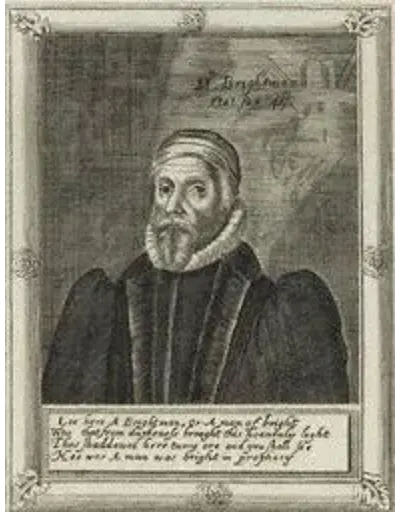
Thomas Brightman (1562–1607) was an English clergyman and biblical commentator. His exegesis of the Book of Revelation, published posthumously, proved influential. According to William M. Lamont, Brightman and Joseph Mede were the two most important revisionists of the interpretation and eschatology set down by John Foxe; among Brightman's contributions was to weaken the imperial associations tied to the Emperor Constantine I. The detailed reading, in favour of the Genevan and Scottish churches, and condemning the 'Laodicean' (lukewarm) Church of England, helped to move on the Puritan conceptions of church reform and its urgency.
