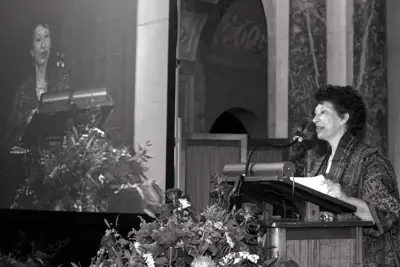
Fatima Mernissi Quotes
The modern Muslim state has never presented itself as secular. Muslim nationalist forces, trapped by a militant and colonialist West unable to share or export its humanism, were driven to build up a rampart, to entrench themselves within the past.
Mernissi, Fatima. Islam and Democracy: Fear of the Modern World. Addison-Wesley, 1992.


a political party. In the early days of the Muslim religion, the entire Middle East was under the authority of the Caliph who had both religious and civil authority—very much like the Pope did in Europe. However, corruption, independent tribes, feuds, and civil wars destroyed the Caliphate and there has been no common Islamic leader since. Some Muslims want to eradicate the individual countries and restore the Caliphate.

Religious obligation of Islam requires all Muslims to try and convert all others. However that is not different from some of the Christian, fundamentalist religions where attempted conversion of non-believers is a duty. However, where many in the Islamic world see that obligation as a peaceful, nonviolent, effort to persuade others to accept Islam, there are many others who believe that Jihad should impose Islamic law—Sharia—upon the world and the use of force and violence is not only acceptable but is necessary and desirable to achieve their objection.


Turkey had become a modern, secular nation under the leadership of Ataturk. At the time of this interview, a religious party had won a plurality of seats in the Parliament and while not rolling back the secular nature of the Turkish state which is enshrined in the Turkish Constitution, has tried to stem the tide of secularism.

The Caliph in the past was the religious and secular leader of all Muslims. Many of the fundamentalist terrorists have as their objective, the reestablishment of the Caliphate which will unite all Islamic countries under one leader who is both the secular and religious supreme authority—a religious and a civil dictatorship. Most Muslims, like most people of all religions, are not terrorists and believe that much of terrorist activity violates many basic tenets of Islam. However, in order to function, the terrorist must have the tacit support of sufficient numbers of people so that they can function without being exposed. That is an important objective for Al-Qaeda: to enlist sufficient numbers of ordinary people who although they will not commit the terrorist acts, will support the objectives of the terrorists and provide money, shelter, and other services.
This quotation was reported to Congress by Thomas Jefferson. Essentially, this religious justification is no different from that made by contemporary Islamic extremists. Particularly interesting is the last sentence. The Koran states that all Muslims who die defending Islam will go immediately to heaven regardless of their previous sins and transgressions. Under that justification, even criminal extortion and terrorism is justified by some Muslims whenever the victims are non-believers.


Slogans taken from posters listing 10 people targeted by Muslim extremists. Most were people who had said or published material that some fundamentalist Muslims had decided were offensive to Islam. One was Charlie Hebdo, the French Publisher who Islamic terrorists murdered later. Note the Americanisms that the terrorist propagandists adopted. The Wanted Dead or Alive was taken from the posters of the American West of the 19th century. The "Yes we can" was lifted from the Barack Obama 2008 campaign slogan. The "Bullet A Day Keeps the Infidel Away" is a takeoff on the American saying "An apple a day keeps the Doctor away." One of the reasons for these Americanisms was that the founding editor was Samir Khan, self-described American traitor.

“Disbelievers” are non Muslims. The “Ummah” is the Arabic term for the Muslim Community as a whole. Note that this fundamentalist religious party is not only against the non-Muslim West, but it also opposes most of the leaders of the Muslim countries of the world on the grounds that they are nationalist and do not represent the Ummah of the Muslim world. So ironically, this party is not only opposed by the democracies of the world (Islamic and not) but also the Muslim Dictatorships such as Syria who arrest all members of the party periodically.
The Governor had introduced Sharia, Islamic Law, into his state. When a woman was sentenced to death by stoning, the Federal Government nullified the sentence on the ground that stoning was not morally right nor was a death penalty for her actions. The woman was not executed

The last Caliph of the Muslims was removed in 1924 as part of the Turkish Reform. The position has had attraction for many Muslim leaders who saw themselves in the role, but since 1924, nationalism and modernism and the lack of an effective international Muslim leader has precluded it. This anti-revolutionary sentiment of the Islamic political state that is so traditional, may in part account for the Islamic tolerance of autocratic regimes. Note that the distinction between religious responsibilities and civil are important. Tyranny must be tolerated but not blasphemy or heresy. Traditional Muslims provide more tolerance and forbearance for a leader’s civil failings than religious. But Muslims were not the only people to do this. A British prime minister had a view with the same conservative logic. See {639130}. The ancient Jewish Macabean revolt against the Jewish king was all based on failure to perform required religious duties of sacrifice as opposed to tyranny and poor government which also existed. Popes excommunicated Kings for religious reasons, not because of their civil failures at governing. Holding rulers accountable for civil performance is a relatively new concept yet is indispensible in a modern democracy.
The last Caliph of the Muslims was removed in 1924 as part of the Turkish Reform. The position has had attraction for many Muslim leaders who saw themselves in the role, but since 1924, nationalism and modernism and the lack of an effective international Muslim leader has precluded it.