Ulysses S. Grant Quotes
The whole public are tired out with these annual autumnal outbreaks in the South.
In the fall session when the legislatures reconvened, there were in many Southern States aggressive attacks on Blacks to suppress their various attempts at equality. Often violence was paramount and Blacks would turn to the President to enforce their equal protection rights of the 14th Amendment which the white Southerners then (and some now) resented. Grant stood up for the principle of enforcement of the 14th Amendment but had little resources to enforce the constitution.
Ulysses S. Grant, 1822-1885, 18th President of the United States (Republican, OH), Letter to the Governor of Mississippi, 1876
Sourced by: Eigen's Political and Historical Quotations


Wilson, a history and government professor and college president before politics, was has been accused of being one of the most racist Presidents since Reconstruction. Prior to his Presidency, the Federal Government had been making steady progress in hiring African Americans. Under Wilson there was a wholesale firing of a large proportion of them. Some apologists argue that his League of Nations and other major aspirations required the votes and cooperation of Southern Senators who insisted that many of the blacks be terminated. At the same time, the KKK was near the zenith of its membership and political power and was an intimidating force. Wilson’s home state of New Jersey not only had a large KKK membership but there were lynching of Blacks in his own state and when Governor and President he never asked for any anti-lynching legislation.

Even in 1837 there were already riots over slavery and race in a number of American Cities. What is particularly interesting about this quotation is Lincoln bemoaning the violance and contrasting the then present with the past when law and order prevailed. Even our greatest President has had a romantic view of the past with respect to law and order, as many Americans have done in almost every American era.

For years through the Jim Crow years, Whites murdered many Blacks with impunity if they were perceived to be uppity or to try and obtain their Constitutionally Protected rights. Most took place in the South. The Negroes were typically tortured, mutilated, burned and hung from trees where they would be left for days as the major purpose was to strike terror in the Southern Black population. The Southern State and local governments never opposed the policy via oratory, legislation of law enforcement. The Federal Government did not interfere either. And much of the FBI under J. Edgar Hoover actually enabled the White Citizen’s Councils and the Klu Klux Klan. The NAACP began an anti-lynching campaign and Ms. Holiday was a one-woman public exposure campaign centered around this song. The anthem itself was written by a New York City schoolteacher named Abel Meeropol, using the pen name, Lewis Allan. It reached millions of Americans and Holiday fans the world over. To view some of the historical scenes described in the song, see http://withoutsanctuary.org/main.html


Lincoln had instituted the first draft in American History and it was terribly resented by many Americans. The draft laws allowed the wealthy and upper middle class to avoid service by paying a $300 fee of hiring a substitute just like in the Vietnam War the upper classes could get College Draft deferments. The mob led mostly by poor Irish, began by protesting the draft; then they attacked the mansions and houses of the wealthy; and then they went after Blacks. The Irish poor feared large numbers of Negroes coming out of slavery and competing for their jobs and lowering the prevailing wages. Blacks were beaten and lynched and 5,000 almost half of the then Negro population were driven to Brooklyn, New Jersey and the New York suburbs. It was the worst riot in United States History.

The “stake” refers to burning at the stake, one of the methods of murder used in the South to intimidate Negroes and whites who might hold anti-slavery sentiments.
Southerners and some others wanted to discriminate and fought civil rights legislation. The excuse they gave for opposition was that the Federal Government was usurping the power of the states to determine what civil rights people of the state would have. Shellabarger made it clear that the civil rights bill would not require ANY rights to be given. It just required that if the states granted rights, they could not discriminate by race as to those rights. But the states were free to decide which rights all citizens of the state would have. See {623473} .

This marvelous quotation gives us a picture of the essence of the conflict in conception of freedom between Southern whites and negroes. There was no way to change the large majority of whites’ opinions and it is easy to see why Jim Crow and Southern discrimination evolved as it did. The emancipated Blacks had insufficient power or resources and there was not enough effort or success at changing white attitudes and no where near enough law enforcement to impose the view on the majority of the Southern white population.

the white Southern racist system She was one of the first prominent white southerners to denounce racial segregation.

Blacks were fighting and dying in WWII. They were equal when they were under fire, but otherwise not. The war was against fascist protagonists whose creed was inequality while the allies were upholding freedom and equality. But making that aspiration a reality was difficult.

The bill never became law although it had quite a bit of support.


Reconstruction was the period in the South after the Civil War. The change that emancipation brought to the white South was traumatic, and there was a constant struggle between those who wanted the Blacks to be integrated into Southern Society—and those Southerners who wanted to create a society that would be as close to slavery as possible, So the Klu Klux Klan and other terrorist organizations formed and with lynching and other intimidation, much of the initial progress of Reconstruction was rolled back and did not get reinstated until the Civil Rights and Voting Rights Acts were passed in 1964.
Indeed, he was wrong in the sense that the Southern whites did NOT even obey the letter of the law. The Klu Klux Klan and the rest of Southern Jim Crow terrorism broke the laws of the states and local communities as well as Federal law but they did so with impunity. Andrews recognized the problem but never suspected that it would be as bad as it got with public torture and lynching commonplace and approved by most white Southerners.
After the Civil War and Reconstruction, the American nation was still bitterly divided intelelctually, socially, emotionally and poliotically. In an effort to bring more unity to America, most of the power stucture and the influentials of the nation began to avoid those issues that would divide North and South and try and promote a narrative that both sides might be able to live with. And this is what Zeitz describes in this quotation. America went through a period of Revisionist History that even in the 21st century was held by many people. It wasn't until the middle of the 20th century that the real history and narrative of the Civil War and Reconstrution emerged from the few academics who had all along criticized the fabricated narritive that did unify the country at the cost of historical accuracy and truth. Many scholars point out that the price that America paid for this unity was the Jim Crow era and a century of legalized racism. Much of the nation was built on the labor of Negro slaves and the victims of the slavery era, also bore the brunt of American unity and reconcilliation.

In the 1930s African Americans who traveled were subject to countless humiliations whenever the sought hotels, rooming houses, restaurants and other accommodations. Gas stations would not allow them to use bathrooms and they were reduced to using open fields. Traveling and vacationing was, for Blacks, humiliating. Wikipedia: “Green reviewed hotels and restaurants that did business with African Americans during the time of Jim Crow laws and racial segregation in the United States. He printed 15,000 copies each year. In the 1930s, Green began his work by compiling data on stores in the New York area that accepted black travelers, and published his first guide in 1936. Similar guides had been published for Jewish travelers, who sometimes faced discrimination. Green's guide was so popular that he immediately began to expand its coverage the next year to other US destinations, adding hotel and restaurants as well.”
Professor Egerton documents how successful Reconstruction was in radically changing the positions of Blacks in the South. He points out that it was so effective that a hate-filled, racist group of Southern White terrorists, with murder, arson, torture and intimidation took over many of the governments of the South while President Andrew Johnson, who although he believed in the Union, was himself an inveterate racist and opponent of emancipation, would not use the force of the Federal Government to bring the terrorists to justice. (The KKK leaders were known in every state and county). They successfully overthrew Reconstruction and set the process back by 100 years.

This quotation illustrates how the racist South defeated the objectives of the Civil War and Reconstruction by the institution of Jim Crowe laws and so called “states’ rights”. It would take more than another half century for the Yankees and the vast majority of the non-Southern Americans decided that the Southerners could no longer “do as they pleased” with fellow human beings. It is hard to believe for us today that an entire section of our country could actually believe in the morality of the South but that is the tragic history of race relations in America.
The law enforcement officers were the ones who broke the law when they beat and brutalized the peaceful civil rights marchers. The “white niggers” refer to the white marchers including clergy.
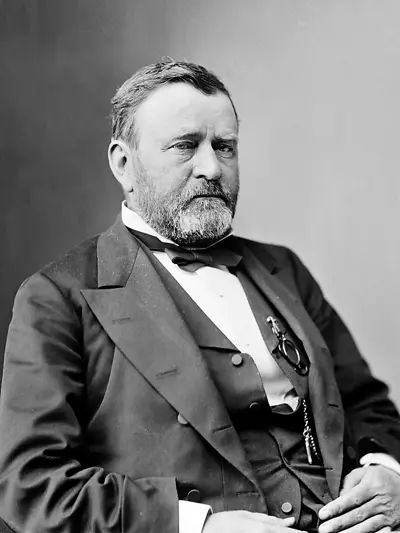
Ulysses S. Grant was an American military leader who served as the 18th president of the United States from 1869 to 1877. As president, Grant was an effective civil rights executive who created the Justice Department and worked with the Radical Republicans during Reconstruction to protect African Americans. As Commanding General, he led the Union Army to victory in the American Civil War in 1865 and thereafter briefly served as Secretary of War.
