Leo XIII Quotes
[The U.S. Church] would bring forth more abundant fruits if, in addition to liberty, she enjoyed the favor of the laws and the patronage of the public authority.
Leo XIII, 1810-1903, Roman Catholic Pope, Longinqua, January 6, 1895
Sourced by: Eigen's Political and Historical Quotations


First Irish Bishop in the United States and the First Catholic Cardinal of New York. Major anti-draft riots had broken out in New York City. Many of these were led by poor Catholics who resented the fact that they had to fight and perhaps die while the rich could be exempted by paying $300. Many Negroes and others were murdered, homes of the wealthy were sacked, and the militia had to be called out to restore order.

Catherine II—the Great—appointed a commission to suggest model laws for Russia based on some of the principles of the European Enlightenment. The laws were never officially adopted but they are interesting in that they were the product of “liberal” thinking at the time. This particular definition of “liberty” is similar to that ruse in many country’s modern constitutions which will “guarantee” a right like freedom of speech so long as it does not violate any laws.

Bishop Ames had been appointed by the war department to take charge of all the Christian churches in the Southern states as they were defeated. The reason is that most Southern clerics were advocates of the rebellion. However many Northern churches, especially those in border states also contained ministers who were not only preaching treason but also aiding the Southern cause. The President thought that the War Department’s order gave Ames authority over all churches where the minister aided the rebellion. So he wrote to Ames limiting the authority. After the President was assured that Ames authority would only extend to Southern churches that had been in the rebellion, Lincoln allowed Ames to appoint ministers and control churches. This is the only time in American history that the Federal government actually controlled churches directly.

In addition to being a Roman Catholic priest, Father Coughlin was an outspoken radio commentator who was well known for his controversial political opinions, see {598783}, {598784}.

This decree is an example of the Catholic Church’s official response to the advent of slavery in the New World. Slavery here should be distinguished from what the Catholic Church called “just title” slavery, which approved of the practice in circumstances in which the person was deprived of their liberty justly. Specific examples have included slaves captured in war, persons condemned to slavery for a crime, and those who sold themselves into slavery. For an example of a type of “just title” slavery being legitimatized, see Nicholas V {612174}. The practice of enslaving entire ethnic groups like South American natives was, however, “never before heard of” and was immediately condemned. In many cases the line between slavery for no morally justifiable reason, i.e. racial slavery, and “just title” slavery remained unclear to Catholic laity and clergy alike.

It is an error to say that. It is an error to say that He was the last Pope to hold temporal power. Years later, the Vatican rejected this view and adopted the modern concept of freedom of conscience. See {612714}.


Prior to Vatican II, freedom of conscience was not explicit in Catholic Doctrine. The controlling view had been that of Pope Pius IX a hundred years earlier. See {612299}.


Young and the Mormons sent missionaries to many counties and made many converts. Since few countries provided a great deal of religious freedom, Young and other Mormons believed that God himself had created America with its freedom. Ironically, it was this advertising of America as a land of freedom that caused many Americans to discriminate against Mormons. The issue of Mormonism was conflated with a strong nativist and anti-immigrant sentiment that has existed among a part of the American population throughout its history. Many opposed the Mormons for the main reason that they were encouraging and in many cases aiding large numbers of immigrants to the United States.

The call for individual liberty and the right of personal property by clergy is surprising to many. This Cahier was the consensus of the Clergy of Blois in 1789. There were cahiers of several provinces of France—some by the clergy, some by the nobles. What is fascinating is the emergence of many of the pre-Revolutionary French concepts. The example of the American revolution and its principles was known throughout the educated classes of France.

While most of the Council of Trent was very conservative in that they were dealing with the threat of Reformation and the Protestants, this particular Cannon is profoundly liberal. Women, who had virtually no rights had often been “sent” to a convent by a father or guardian, the local priest or bishop, and in some cases even a husband. This established for the first time that women could not be forced to take vows—a major step in the evolution of the freedom of women in Western society.
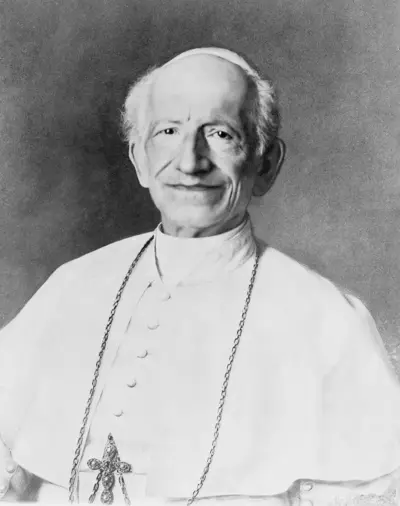
Pope Leo XIII was the head of the Catholic Church from 20 February 1878 to his death in 1903. He was the oldest pope (reigning until the age of 93), with the exception of Pope Benedict XVI as emeritus pope, and had the third-longest confirmed pontificate, behind those of Pius IX (his immediate predecessor) and John Paul II.
