Herbert Hoover Quotes
A whole people with the ballot in their hands possess the most conclusive and unlimited power ever entrusted to humanity.
Hoover, Herbert. The Challenge to Liberty. Charles Scribner's Sons, 1934, p. 153.


These three principles not only were the philosophical and political lynchpins of the Chinese Republican efforts but were incorporated into the first line of the national anthem of the Republic of China which became the government of Taiwan when the Chinese Communists won the mainland and the rest of China. The nationalists only delivered one of the three: Nationalism and that with much corruption. The Communists delivered two with less corruption and thus won China.


This was a classic debate over universal male suffrage. Rainborough had made a forceful argument for equality as a spokesperson for the Levellers in this famous debate. Ireton (See {619711}) eloquently gave the classic counter-argument that property owners had much more at stake and therefore should have much more of a say on governmental affairs. Early America actually sided with Ireton but modern America holds with Rainborough.


This illustrated the problem with Nazi Germany where Hitler was elected by the people. In a Constitutional democracy such as the United States, when an elected President attempts to cut away constitutionally insured freedoms, there is public opinion, the press, a Congress and a Supreme Court to check him as occurred in the George W. Bush Administration over wiretapping, torture, and handing of war captives. These were checked, but they were minor and trivial compared to Nazi Germany’s abuse of freedom. In Germany, Hitler weakened or destroyed all those who might check his power and therein lies the essential difference. The despot must eliminate or weaken the checks on him. In the American democracy, the Congress finally checked John Adams’ Alien & Sedition Act as did public opinion by turning him out of office after one term. But in each case, in democracy or dictatorship, the same argument is often made if the elected leader impinges on some freedoms: it is legitimate because he represents the will of the people. Spencer and many others have always disagreed.


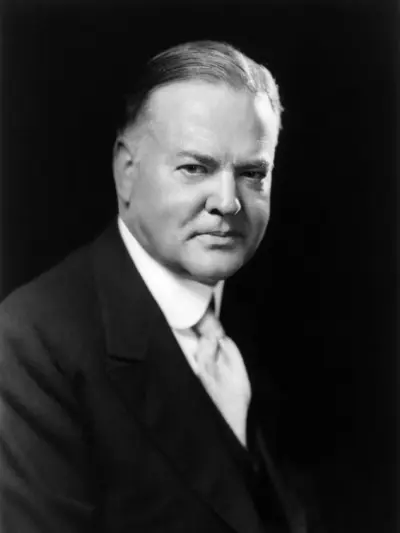
Herbert Clark Hoover was an American politician, businessman, and engineer, who served as the 31st president of the United States from 1929 to 1933. A member of the Republican Party, he held office during the onset of the Great Depression. Before serving as president, Hoover led the Commission for Relief in Belgium, served as the director of the U.S. Food Administration, and served as the third U.S. Secretary of Commerce.
