George Baden-Powell Quotes
The ultimate unit, the taxpayer – whether home or colonial – looks for two groups of results as his reward. On the one hand, he hopes to see Christianity and civilization pro tanto extended; and, on the other, to see some compensating development of industry and trade. Unless he, or 'his servants the Government,' secure either or both these results, the question must be plainly asked, Has he the right, and is he right, to wage such wars?
George Baden-Powell, 1847–1898, British Colonial Commissioner in Australia, the West Indies, Malta and Canada, Quoted in John A. Hobson, Moral and sentimental Factors, Part II: The Politics of Imperialism, Imperialism, A Study, 1902
Sourced by: Eigen's Political and Historical Quotations


The speech was never actually delivered, but instead the Bishop published it. It received wide distribution including in America where it was published by the Maryland Gazette on September 29, 1774.

This quotation is an excellent example of the early, militant Gandhi. It is typical of militant theocracies of the Islamic world today.


He had concluded that Spain, who then ruled the Philippines, was incompetent, cruel and immoral in its rule, but that the Filipinos were not educated or sophisticated enough to rule themselves. However, he felt that he had to protect our commercial interests in the islands and the region, and was worried that commercial interests of other countries would take over and control the area. Another reason that this is a very important quotation is that it indicates the anti-Catholic bias in America at the time. Note that the President stated that one objective was to “Christianize” them. However, Spain had been in the islands for over 300 years and most Filipinos were already Roman Catholic. However, Roman Catholics were then a much smaller proportion of the American population and many Protestants didn’t think Catholicism was a legitimate Christian Religion. When the majority of Americans thought of Christianizing other people, they thought of Protestant missionaries much like England. At the time there was very little criticism of the President for the “error” of stating that Filipinos should be Christianized when they were so already Spanish Colonial Policy and Practice was generally terrible and particularly so in the Philippines, See {629450}.


The Punjab, like Afghanistan and some other areas had no real tradition of government. The Sikhs of the Punjab had initiated a war with the British Colonial Empire—The 1st Anglo-Sikh War—which ended with a decisive British victory and a peace treaty where the rulers of the Punjab agreed to keep the peace. However, they really could not control the population and some Sikhs again attacked British and Muslim interests. The Governor-General reported that treaties and commitments with the Punjab leaders really meant little. The British also won the 2nd Anglo-Sikh War-. The Governor-General was determined that there would not be a 3rd war with the Sikhs of the Punjab.
The Punjab, like Afghanistan and some other areas had no real tradition of government. The Sikhs of the Punjab had initiated a war with the British Colonial Empire—The 1st Anglo-Sikh War—which ended with a decisive British victory and a peace treaty where the rulers of the Punjab agreed to keep the peace. However, they really could not control the population and some Sikhs again attacked British and Muslim interests. The Governor-General reported that treaties and commitments with the Punjab leaders really meant little. The British also won the 2nd Anglo-Sikh War.

Hong Kong was not always a successful city or colony. In 1844 the British were thinking of swapping it for a better colony. However, in a rare combination of synergistic development of a colony, the great strengths of the Chinese and that of the English combined to make Hong Kong one of the best and well developed cities in the world. Few imperial colonies turned out as well.


The profits that England made on the North American Colonies and the Caribbean were very large. 10 years before the American Revolution most sophisticated English politicians realized that and one of the reasons the British fought so hard to keep America from Independence was that money.


This is the same man who introduced the Stamp Act 12 years before which started the whole problem in America. See {74956}.
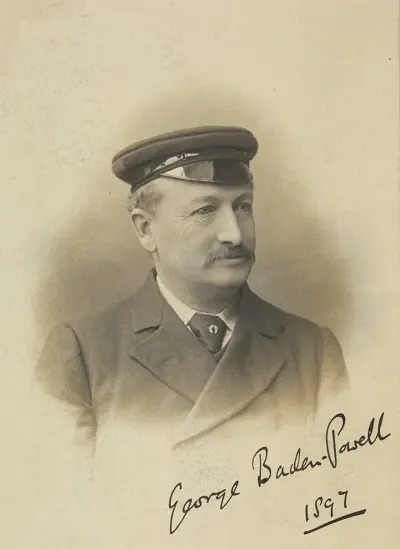
Sir George Smyth Baden-Powell, KCMG, was a son of the mathematician, the Rev. Prof. Baden Powell. He was also the brother of: The 1st Baron Baden-Powell; Baden Baden-Powell; Warington Baden-Powell; Agnes Baden-Powell; and Frank Baden-Powell. After graduating at Balliol College, Oxford, and studying at the Inner Temple, he acted as a commissioner in Victoria, Australia, the West Indies, Malta and Canada.
