William McKinley Quotes
There was nothing left for us to do but to take them [the Philippine Islands] all, and to educate the Filipinos, and uplift and Christianize them.
He had concluded that Spain, who then ruled the Philippines, was incompetent, cruel and immoral in its rule, but that the Filipinos were not educated or sophisticated enough to rule themselves. However, he felt that he had to protect our commercial interests in the islands and the region, and was worried that commercial interests of other countries would take over and control the area. Another reason that this is a very important quotation is that it indicates the anti-Catholic bias in America at the time. Note that the President stated that one objective was to “Christianize” them. However, Spain had been in the islands for over 300 years and most Filipinos were already Roman Catholic. However, Roman Catholics were then a much smaller proportion of the American population and many Protestants didn’t think Catholicism was a legitimate Christian Religion. When the majority of Americans thought of Christianizing other people, they thought of Protestant missionaries much like England. At the time there was very little criticism of the President for the “error” of stating that Filipinos should be Christianized when they were so already Spanish Colonial Policy and Practice was generally terrible and particularly so in the Philippines, See {629450}.
William McKinley, 1843-1901, 25th President of the United States (Republican, OH), Explanation of his decision to invade and occupy the Philippines
Sourced by: Eigen's Political and Historical Quotations


In 1898 the President was faced with a great dilemma in the Philippines. Giving the islands back to Spain after the war was unthinkable. Germany and France were waiting to step in. Self government was viewed as impractical, given the state of affairs at the time. The President decided to take the islands.


On July 7, 1898 the United States annexed Hawaii through a transparent aggression posing as a revolution.


The neo-conservative expectation of the American invasion of Iraq almost a century later was essentially the same, and the false expectation led to the same kind of failure as the George W. Bush debacle of the early 21st century.


This church which was so active later in sending missionaries throughout the world, at first thought the idea absurd.


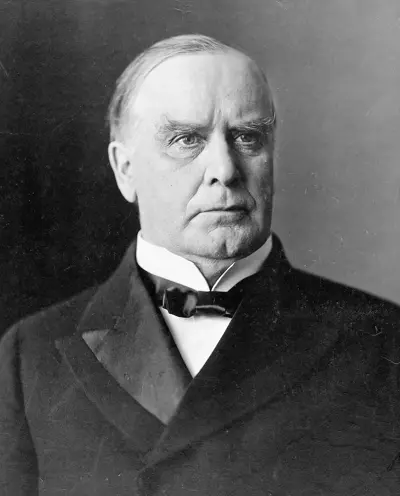
- Born: January 29, 1843
- Died: September 14, 1901
- Nationality: American
- Profession: President
William McKinley was the 25th president of the United States, serving from 1897 until his assassination in 1901. McKinley was president during the Spanish–American War of 1898, raised protective tariffs to boost American industry, and rejected the expansionary monetary policy of free silver, keeping the nation on the gold standard.
