Henry A. Kissinger Quotes
The superpowers often behave like two heavily armed blind men feeling their way around a room, each believing himself in mortal peril from the other, whom he assumes to have perfect vision.
Kissinger, Henry. White House Years. Little, Brown and Company, 1979, p. 522.


Chamberlain’s military assessment of Russia’s military ability was yet another example of his faulty judgment. He was not alone however in that many British military experts and American as well, thought that Stalin and Russia could not hold out against Hitler and any military aid given to Russia would just fall into German hands. It was FDR assistant Harry Hopkins who went to Russia, toured the front, met with Stalin and other Russian leaders and observed the Russian people and then recommended to FDR that we send arms to Russia. It was a critical judgment. In the end, the Germans suffered more casualties on their Russian front than any other part of the war and it was the Russians who took Berlin though they suffered large casualties themselves.


1st Earl Baldwin of Bewdley. Baldwin has been castigated since WWII for being part of the “appeasement group” in England. As Prime Minister in 1935 he would not face the threat of Fascism, Germany and the Nazis and did not initiate a major arms buildup. Churchill, among others, never forgave him. See {626930} for Churchill’s view of Baldwin.

He was exactly right. See {642079} for a perfect example of this prediction.


Baruch was the first politician to use of the phrase "cold war." It had actually been originated by a friend and speechwriter, Herbert Bayard Swope, who had proposed using the phrase earlier. Baruch thought that too early and waited.


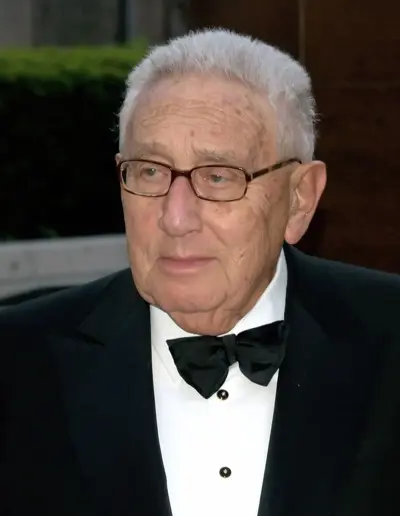
Henry Alfred Kissinger KCMG is an American politician, diplomat, and geopolitical consultant who served as United States Secretary of State and National Security Advisor under the presidential administrations of Richard Nixon and Gerald Ford. A Jewish refugee who fled Nazi Germany with his family in 1938, he became National Security Advisor in 1969 and U.S. Secretary of State in 1973. For his actions negotiating a ceasefire in Vietnam, Kissinger received the 1973 Nobel Peace Prize under controversial circumstances, with two members of the committee resigning in protest.
