Neville Chamberlain Quotes
I must confess to the most profound distrust of Russia. I have no belief whatever in her ability to maintain an effective offensive, even if she wanted to.
Chamberlain’s military assessment of Russia’s military ability was yet another example of his faulty judgment. He was not alone however in that many British military experts and American as well, thought that Stalin and Russia could not hold out against Hitler and any military aid given to Russia would just fall into German hands. It was FDR assistant Harry Hopkins who went to Russia, toured the front, met with Stalin and other Russian leaders and observed the Russian people and then recommended to FDR that we send arms to Russia. It was a critical judgment. In the end, the Germans suffered more casualties on their Russian front than any other part of the war and it was the Russians who took Berlin though they suffered large casualties themselves.
Neville Chamberlain, 1869-1940, British Prime Minister (Conservative), Diary entry March 26, 1939
Sourced by: Eigen's Political and Historical Quotations


Russia then had designs on Afghani Territory. About a century later, Russia Invaded Afghanistan and tried to impose a communist government. It failed and the Afghans drove out the Russians.

The Scientific Project that developed the Atomic Bomb. He was a strong advocate for disarmament and that was being debated at the United Nations. He was critical of Bernard Baruch’s tactics but it soon was clear to almost all that the Russians were not interested in a serious UN supervised disarmament. Oppenheimer was profoundly disappointed when it was clear that disarmament was being blocked by the Russians and their veto. After that he didn’t trust the Russians, and concentrated on trying have US policies that would not goad the Russians into an arms race. This quotation is particularly important because in an effort to discredit his views on nuclear policy some politicians accused him of being a security risk with the innuendo that he was a communist and even a Russian agent.


The Germans had invaded Russia who despite losing over 20 million people continued to fight the Germans who had never had to deploy forces over such a large territory. But it was the severe Russian Winter that turned the tide. Germans were not equipped or dressed for the terrible winter. The Russians were used to it. The Germans were repulsed and had to retreat back into Germany.


Truman had to deal with Stalin for many years. In earlier days he had a much more favorable view of the Russians. See {626410} for his view 22 years earlier.

Most American felt that way at the time of the Russian occupation and the Mujahedeen resistance.


After the breakup of the Soviet Union, NATO expanded to include some fo the former Soviet Nations thus moving NATO territiry to the East--closer to Russia, whose leaders percieved that the expansion was hostile and dangerous for the indpendence of Russia. What made the situation more complex is that the American Secretary of State, when the Soviet Union was very powerful, had made an agreement with the Soviets that in return for Russian aquiessance of NATO being extended to East Germany, NATO would not expand further West. But after the collapse of the Soviet Union, Russia was quite weak and NATO expanded east despite the earleir comittment. The US and th eother NATO counties took the pozition the previous comitmnts were not binidng as they were never formally signed. The Russians then decided to take a hard line position and flaunt and use military force to which would stop the Western expansion closer to the Russian border.


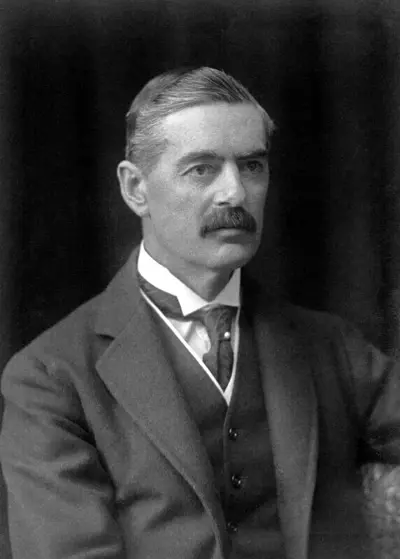
Arthur Neville Chamberlain FRS was Prime Minister of the United Kingdom and Leader of the Conservative Party from 1937 to 1940. He is best known for his foreign policy of appeasement, and in particular for his signing of the Munich Agreement on 30 September 1938, conceding the German-speaking Sudetenland region of Czechoslovakia to Germany. Following the German invasion of Poland on 1 September 1939, which marked the beginning of World War II, Chamberlain announced the declaration of war on Germany two days later and led the United Kingdom through the first eight months of the war until his resignation as prime minister on 10 May 1940.
