Carter Glass Quotes
The suggestion that we may devaluate the gold dollar fifty per cent means national repudiation. To me, it means dishonor. In my conception of it, it is immoral.
Carter Glass, 1858-1946, U. S. Congressman & U. S. Senator (Democrat, VA), U. S. Secretary of the Treasury, Quoted in Smith and Beasley, Carter Glass, 1939
Sourced by: Eigen's Political and Historical Quotations


The “Fed Note” was the term for a Federal Reserve Note. It was a then a new form of paper money issued by the Federal Reserve Banks instead of the Treasury department as the previous United States Notes had been. The United States was a guarantor of the Federal Reserve Notes in case the Federal Reserve defaulted and there were many who feared having the responsibility to back up the Federal Reserve notes which could be issued by the Federal Reserve Banks—not government entities and not under the control of the President or Congress.

At the time the United States was on the Gold Standard and all our money was backed by gold. Root and others were afraid that a Federal Reserve Bank, a proposal that was being debated in Congress, would cause a large amount of paper money to be printed which other nations would obtain through trade and then exchange that for American gold—a process which would deplete the American gold supply. A few years before, William Jennings Bryan had argued that the Gold Standard did not allow America sufficient ability to increase the money supply to serve the growing population and economy. See {640992}.


The Hoover administration had lost control of the economy. The nation was in a depression. Banks were failing. Gold was being hoarded and taken out of circulation while we were on the gold standard. Roosevelt’s solution was to decouple American money and gold—a solution that William Jennings Bryan had suggested many years earlier. See {640978}.

The same argument can be made against the modern paper money supply. What Jefferson and most of the founding fathers, with the exception of Alexander Hamilton. did not realize was that the major stability of any kind of money was not only the silver or gold that backed it but the political and legal stability of the nation and the size of its productive economy. Where Jefferson was right however is that all these banknotes at the time were issued by local private banks. The Government had no responsibility for paper money and had no knowledge of how much paper money any bank issues and whether or not they had any silver to back it up. Banks didn’t trust other bank’s notes and would only redeem them at a discount. A $10 note from a South Carolina bank might only be worth $7 in New York and $6 in Boston. The early American monetary system was a mess.


This is an excellent historical example of how damaging it can be for a country if its leaders do not understand the technicalities of economics and currency manipulation.

The exact phrase has not been found in Gresham's writings but the idea appeared in a 1558 letter to Queen Elizabeth I. The expression has come to be known as Gresham's Law.

Describing the currency situation of the country:


The sentence was actually drafted by Secretary of the Treasury Salmon Chase.

The assumption was that money would always be backed by gold or silver. In effect, raising or allaying the money was to change the amount of gold or silver that a particular denomination of money would be able to be exchanged for. This is one of the interesting proofs that these processes did nothing economically—for if they could, no one would want the money. This has always been a weakness or a strength—depending on one’s political point of view—of a gold standard.
While devaluation may have been intended to have the effect of stimulating exports and inhibiting imports, many countries have populations which feel “cheapened” by the process—that they are worth less as laborers and their raw materials are valued less in the eyes of the world.
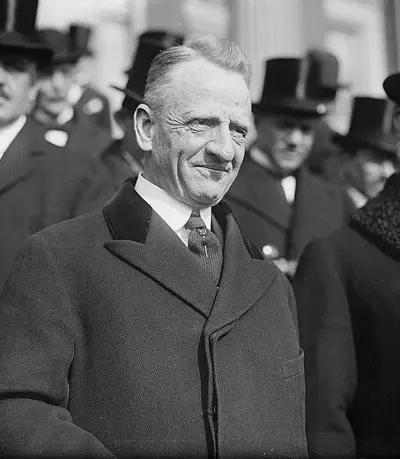
Carter Glass was an American newspaper publisher and Democratic politician from Lynchburg, Virginia. He represented Virginia in both houses of Congress and served as the United States Secretary of the Treasury under President Woodrow Wilson. He played a major role in the establishment of the U.S. financial regulatory system, helping to establish the Federal Reserve System and the Federal Deposit Insurance Corporation.
