Albert Gallatin Quotes
... a baseless currency varying every fifty miles and fluctuating everywhere.
Describing the currency situation of the country:
Albert Gallatin, 1761-1849, U. S. Congressman & U. S. Senator (PA, Anti-Federalist), U. S. Secretary of the Treasury, Ambassador to Great Britain, Ambassador to France, December 1815
Sourced by: Eigen's Political and Historical Quotations

The “Fed Note” was the term for a Federal Reserve Note. It was a then a new form of paper money issued by the Federal Reserve Banks instead of the Treasury department as the previous United States Notes had been. The United States was a guarantor of the Federal Reserve Notes in case the Federal Reserve defaulted and there were many who feared having the responsibility to back up the Federal Reserve notes which could be issued by the Federal Reserve Banks—not government entities and not under the control of the President or Congress.


The same argument can be made against the modern paper money supply. What Jefferson and most of the founding fathers, with the exception of Alexander Hamilton. did not realize was that the major stability of any kind of money was not only the silver or gold that backed it but the political and legal stability of the nation and the size of its productive economy. Where Jefferson was right however is that all these banknotes at the time were issued by local private banks. The Government had no responsibility for paper money and had no knowledge of how much paper money any bank issues and whether or not they had any silver to back it up. Banks didn’t trust other bank’s notes and would only redeem them at a discount. A $10 note from a South Carolina bank might only be worth $7 in New York and $6 in Boston. The early American monetary system was a mess.


At the time the United States was on the Gold Standard and all our money was backed by gold. Root and others were afraid that a Federal Reserve Bank, a proposal that was being debated in Congress, would cause a large amount of paper money to be printed which other nations would obtain through trade and then exchange that for American gold—a process which would deplete the American gold supply. A few years before, William Jennings Bryan had argued that the Gold Standard did not allow America sufficient ability to increase the money supply to serve the growing population and economy. See {640992}.


This is the first major history of banks written in the United States.

“Pegged” exchange rates are a country’s money where the Government sets the value of the money in terms of some other currency—usually American dollars. The advantage of a pegged currency is that it is stable and does not fluctuate day to day. The disadvantage is that people realize that the value is artificial and other countries will not accept the pegged currency. Worse natives try and get as many dollars as they can because the fear that the Government will devalue and change the rate of exchange of the pegged currency.

This was a very astute prediction. At the time, the United States gold mining production was second only to South Africa and American currency was based on the gold standard which seemed to all to be permanent. Half a century later, the U. S went off the gold standard.


What Franklin Delano Roosevelt began, President Nixon would in 1971 complete by removing America from the gold standard entirely and ending fixed rates of exchange. There have been those in government who did not understand the modern economics of money and who believed that currency had to have a fixed rate of exchange for gold or silver otherwise it was worthless. Roosevelt had to deal with them as did Nixon later. Even into the 21st century when it had been amply demonstrated that the best currency in the world was the United States dollar precisely because it was backed up by the full faith and credit of the United States Government, there were those who complain that United States money is not sound currency and argue for the return of the gold standard.

There has always been a fear of inflation and currency debasement by governments. Since ancient times, rulers issued coins and when they were made of cheap metals like copper or iron, the ruler could mint as much as he wanted and when he did so the value went down. By using only precious metals, gold and silver, for coins, there would be a natural restraint on government. Garfield was one of those who believed that we should always have money of gold and silver. The United States would use that principle for the next century even backing its paper money with gold and silver. In the Nixon administration the United States abandoned the gold standard. Today, it is the ability of a country to produce things that maintains value of paper money which has been supplanted in many cases by electronic money.


The exact phrase has not been found in Gresham's writings but the idea appeared in a 1558 letter to Queen Elizabeth I. The expression has come to be known as Gresham's Law.


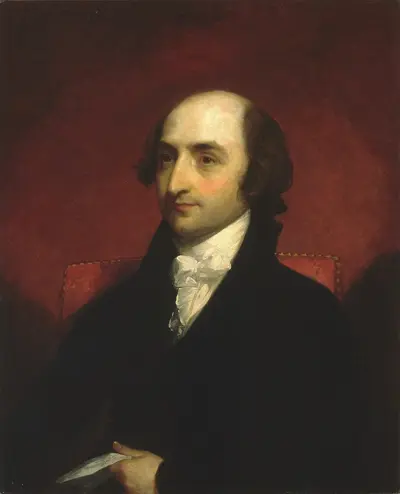
Abraham Alfonse Albert Gallatin, born de Gallatin was an American politician, diplomat, ethnologist and linguist. Biographer Nicholas Dungan states he was "America's Swiss Founding Father." He is known for being the founder of New York University and for serving in the Democratic-Republican Party at various federal elective and appointed positions across four decades. He represented Pennsylvania in the Senate and the House of Representatives before becoming the longest-tenured United States Secretary of the Treasury and serving as a high-ranking diplomat.
