Thomas Gresham Quotes
Bad money drives out good money.
The exact phrase has not been found in Gresham's writings but the idea appeared in a 1558 letter to Queen Elizabeth I. The expression has come to be known as Gresham's Law.
Thomas Gresham, 1519-1579, Founder, Royal Stock Exchange
Sourced by: Eigen's Political and Historical Quotations


This is the first major history of banks written in the United States.


At the time, a bank note—paper money issued be a private bank—was not backed by any gold or silver and was not insured bym the government. A bank could print as much as they wanted, so it was always worth less as the further you were from the particular issuing bank, the less you could get your bank note, because no one knew whether or not the issuing bank would redeem the note or even be in existence. So every private bank note had diminished value for the public. However, carrying gold and silver around and making change for precious metals was difficult and often impractical. So people used banknotes. The same thing happens with credit cards today. The merchant has to pay a fee to the credit card company and the bank and therefore charges us more for whatever we buy. But most consumers and merchants are willing to pay the difference to obtain the convenience of the credit card,

The same argument can be made against the modern paper money supply. What Jefferson and most of the founding fathers, with the exception of Alexander Hamilton. did not realize was that the major stability of any kind of money was not only the silver or gold that backed it but the political and legal stability of the nation and the size of its productive economy. Where Jefferson was right however is that all these banknotes at the time were issued by local private banks. The Government had no responsibility for paper money and had no knowledge of how much paper money any bank issues and whether or not they had any silver to back it up. Banks didn’t trust other bank’s notes and would only redeem them at a discount. A $10 note from a South Carolina bank might only be worth $7 in New York and $6 in Boston. The early American monetary system was a mess.


This was a very astute prediction. At the time, the United States gold mining production was second only to South Africa and American currency was based on the gold standard which seemed to all to be permanent. Half a century later, the U. S went off the gold standard.


Conservatives are surprised to learn that their great economic nemesis was one of the early economists who saw the danger of paper money and government control over the minting of money which is one of their core concerns.


“Pegged” exchange rates are a country’s money where the Government sets the value of the money in terms of some other currency—usually American dollars. The advantage of a pegged currency is that it is stable and does not fluctuate day to day. The disadvantage is that people realize that the value is artificial and other countries will not accept the pegged currency. Worse natives try and get as many dollars as they can because the fear that the Government will devalue and change the rate of exchange of the pegged currency.

At the time, there was no United States currency. Private banks in some of the states issued their own money. A dollar from Georgia might only be worth 75 cents in New York.

There actually are restraints on how much paper money a government will issue, but unlike with a gold standard where the restraint is external and controlled by how much gold the country can amass. However, with paper money the restraints area all internal. If too much money is printed, the value of the money relative to gold, silver and other nation’s money will go down and imports will become more expensive. Excessive printing of money can easily produce inflation. However, the internal restraints can be overcome by the government’s need to raise money for war, debt or other purposes. So Paul and many other politicians have a deep distrust of paper money not backed by Gold or Silver. In the United States however, the Government does not control the money supply or the printing policies of money. This is under the control of the Federal Reserve Board which while appointed by President’s as terms expire, have a great deal of independence both from the Executive and Legislative Branches. For that reason Paul is even more distrustful when the Federal Reserve decides to print money. See {629491} for his unsuccessful effort to abolish the Federal Reserve Bank.


The alternative would have been for the colonies to borrow English money at high interest rates and use that. Or use money from private banks (which occurred later.) Many conservatives are today a little shocked that some of the American Colonies just printed money with no backing but it worked—at least at the local level. A Boston Bank for example, would take a large commission for a Bostonian to convert Pennsylvania money into Massachusetts money. So it was not a very good system for trade between colonies and International trade. But English money was used for that. The colonists pragmatically got the “best of both worlds” and paid as little interest as they needed to. This system is essentially what we use today on a national scale with no gold or silver backing of the money.

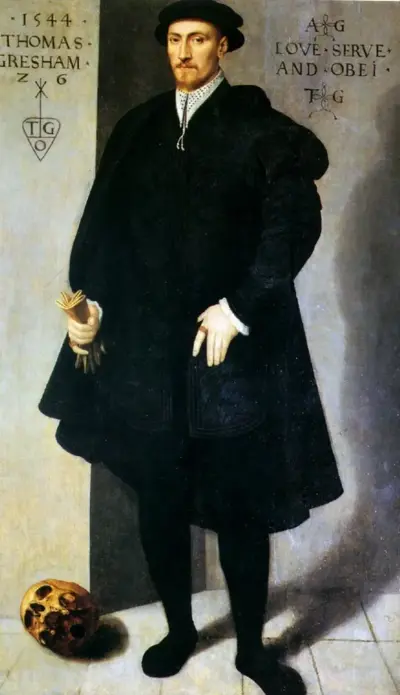
Sir Thomas Gresham the Elder, was an English merchant and financier who acted on behalf of King Edward VI (1547–1553) and Edward's half-sisters, queens Mary I (1553–1558) and Elizabeth I (1558–1603).
