Robert M. La Follette Quotes
The question of primary elections is one of government for the people and by the people. Under our system of government by political parties, two elements, equal in importance, are involved in the exercise of suffrage; one, the making of the ballot; the other, the casting of the ballot. The right to cast the ballot is regarded as sacred. The right to make the ballot is equally sacred. No man would be willing to delegate his power to vote the ballot at general elections. No man shall be compelled to delegate his power to make his ballot.
At the time most candidates were chosen by party leaders in “small, smoke-filled, rooms.” La Follette started the movement for primary elections which are so taken for granted in modern politics. They did not always exist in American history.
Robert M. La Follette, 1855-1925, Governor of Wisconsin (Republican), U.S. Senator (Republican, WI), Presidential Candidate (Progressive), Speech, Milwaukee, WI, 1902
Sourced by: Eigen's Political and Historical Quotations

Slogan that Theodore Roosevelt developed to go with this attempt to nominate Presidents with Primary Elections. Prior to his 1912 run for the Presidency, presidential nominees were selected by the delegates to the party national convention. Since then the parties have used various combinations of delegates that were bound by primary election results in their state and other delegates who could use their judgment. No combination has been totally satisfactory and both major American political parties tinker with the combination every four years.


Some people think that this quotation was partially copied from Lincoln’s Gettysburg Address. However, he gave this speech more than a decade earlier. Lincoln might have been familiar with it. His statue is in the U. S. Capitol.


There is a certain redundancy in that “Fenian” means “Party.”

This is an interesting historical quotation. In 1917, Joseph Stalin, was for democracy and elections with rule by the majority. Once he and his party gained control, the democratic idea of free elections with competition evaporated.


The government relationship to people phrase, although probably Lincoln's most famous, was not totally original. John Adams came close in a 1774 proclamation. As did John Marshall in his McCulloch v. Maryland decision. Daniel Webster's Speech on Foot's Resolution was very close. as was Theodore Parker in 1850 {629578}. There was also Thomas Cooper in 1795. But the earliest appears to be John Wycliffe in 1382 {567292}. It is not known with which of these Lincoln was familiar.


This quotation had a close proximity to Lincoln’s Gettysburg Address (see linked quote). Although this was probably Lincoln's most famous line, it was not totally original. John Adams came close in a 1774 proclamation (see linked quote). As did John Marshall in his McCulloch v. Maryland decision (see linked quote). There was also Thomas Cooper in 1795 (see linked quote). But the earliest close phrase use appears to be the English cleric, John Wycliffe, in 1382 (see linked quote). It is not known with which of these Lincoln was familiar.

For that, the Church burned him at the stake. Note the phraseology and compare it to Gettysburg Address {458852}. It is not known whether Lincoln was aware of this quotation or others that used similar wording.


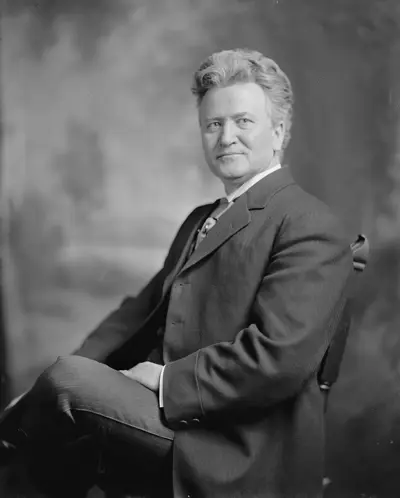
Robert Marion "Fighting Bob" La Follette Sr., was an American lawyer and politician. He represented Wisconsin in both chambers of Congress and served as the Governor of Wisconsin. A Republican for most of his career, he ran for President of the United States as the nominee of his own Progressive Party in the 1924 presidential election. Historian John D. Buenker describes La Follette as "the most celebrated figure in Wisconsin history."
