Alan Dershowitz Quotes
The prosecution... wants to make sure the process by which the evidence was obtained is not truthfully presented, because, as often as not, that process will raise questions.
Prosecutors have a great deal of discretion and do not operate transparently and therefore are at risk for abuse. See {631696}.
Alan Dershowitz, Constitutional Law Scholar and Professor of Law, U.S. News & World Report, August 9, 1982
Sourced by: Eigen's Political and Historical Quotations

Because of the discretion and lack of transparency of prosecutors, she argues that the prosecutors are the weak link in the criminal justice system. Others believe that the weak link is the judges who are the most protected. See {631729}.

This quotation is a great example of the difficulty of deciding some of the major Constitutional issues. Most reasonable people believe that Rehnquist certainly has a point. On the other hand, critics observe that this quotation essentially says that it is OK to convict an innocent person if it cost too much or be too much trouble to do so. Reasonable people would also agree that this objection has much merit also. So the judicial system is stuck with deciding when the cost or trouble is too much. There will never, can never, be a clear cut answer.


Prosecutors, even ones who are frequent lawbreakers themselves violating defendant's rights or illegally manipulating trials, are reluctant to be officially found to have done so. Many politicians start their political careers as prosecutors and then rise to higher office. If it is officially found that they had abused a defendant and violated the law, it can be detrimental to their careers. So in many states, they have placed barriers making it much harder for an improperly convicted person to even get a court hearing. The cost to society however is that they are never accountable, and people have been wrongly imprisoned and cannot even get a hearing to prove that they were the victims of official misconduct. The rationale for these rules that prevent victims from obtaining fairness and justice is finality—the concept that there should be some end to the process of appeals so justice can be said to have been done. It prevents a kind of closure for many of the victims of crimes and their families if the guilty perpetrator is constantly appealing or can do so.

Sunday Excise Laws, sometimes called “Blue Laws”, prohibited commercial activity on Sunday, the day most Christians believe to be the Sabbath. Then such laws had not been constitutionally tested and when the were later were they were all found to be unconstitutional. Some Christian sects believe that Saturday is the Sabbath as do most Jews. Muslims believe Friday is the Sabbath. So any state determination on the Sabbath favors some religious viewpoint and discriminates against others. Today, decisions about Sabbath are left to individual consumers and store owners.


This statement was an extension of the famous quotation of Oliver Wendell Holmes Jr. {603715}.


This was America’s first Presidential impeachment which occurred just a few years after America’s greatest crisis—the Civil War. It was handled in an orderly, serious manner following the law throughout.

See {630401} for a similar quotation.

it is ironic that the witnesses swear to tell the entire truth but the prosecutors, attorneys, and judges are not so bound. Most in actuality often do not reveal aspects of the truth that might undermine their case or with judges, the personal view of judicial administration. Often judges do not tell defendants in criminal trials all their options about protesting the judges actions in the trial for example.
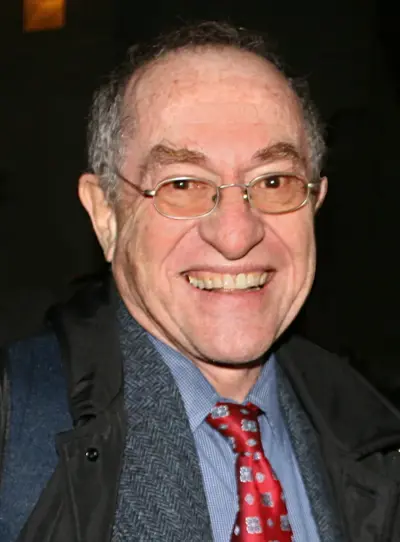
- Born: September 1, 1938
- Nationality: American
- Profession: Former Felix Frankfurter Professor Law At Harvard Law School
Alan Morton Dershowitz is an American lawyer known for his work in U.S. constitutional law and American criminal law, and for controversial political views.
