Gilbert K. Chesterton Quotes
The prophet and the quack are alike admired for a generation, and admired for the wrong reasons.
Chesterton, G. K. William Blake. Duckworth & Co., 1910, p. 11.


Referring to William Jennings Bryan:

Al-Maarri’s quotations are not only meaningful in their own right, but they illustrate the openness and free thinking that was allowed in the early days of Islam before about 1100. If anyone wrote such things today in most Islamic countries he would at least be jailed if not executed for blasphemy. And if any Christian in Europe made the same statement, he would have been excommunicated at least if not tortured and murdered.

Huntington, one of the better known political scientists had been nominated for admission as a fellow of the National Academy of Sciences. He was generally considered a shoe-in. However, some of his research had used extensive mathematical analysis to prove his conclusions. Lang a gadfly had actually read Huntington’s peer reviewed published Journal articles and found that the mathematics was very faulty, both in its application and execution. He opposed Huntington’s election and proceeded to present Huntington’s mathematics and conclusions to the members, who were themselves the best scientists of many different disciplines. They all realized that the Huntington work was incorrect. Huntington argued that as a Political Scientist he was using mathematics as a way of conceptually illustrating his points and not in a rigorous manner. Huntington was not elected to the academy. Lang frequently would take scientific evidence offered in Congressional Hearings, analyze it and then send a package to the media and members of Congress showing the errors. See {508154} for his cutting style with poor science.


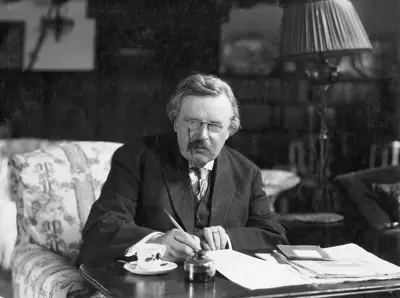
Gilbert Keith Chesterton KC*SG was an English writer, philosopher, lay theologian, and literary and art critic. He has been referred to as the "prince of paradox". Time magazine observed of his writing style: "Whenever possible Chesterton made his points with popular sayings, proverbs, allegories—first carefully turning them inside out."
