Adam Smith Quotes
The property which every man has in his own labour, as it is the original foundation of all other property, so it is the most sacred and inviolable.
Smith, Adam. An Inquiry into the Nature and Causes of the Wealth of Nations. W. Strahan and T. Cadell, 1776.


See {587703} for a similar statement by a Supreme Court Justice.


The call for individual liberty and the right of personal property by clergy is surprising to many. This Cahier was the consensus of the Clergy of Blois in 1789. There were cahiers of several provinces of France—some by the clergy, some by the nobles. What is fascinating is the emergence of many of the pre-Revolutionary French concepts. The example of the American revolution and its principles was known throughout the educated classes of France.


Day was often associated with left wing causes, but she was very hard to classify in traditional political terms. This quotation shows that unlike most communists and many socialists, she was an advocate of private property although she fought for the ability of a larger proportion of the population to have property.


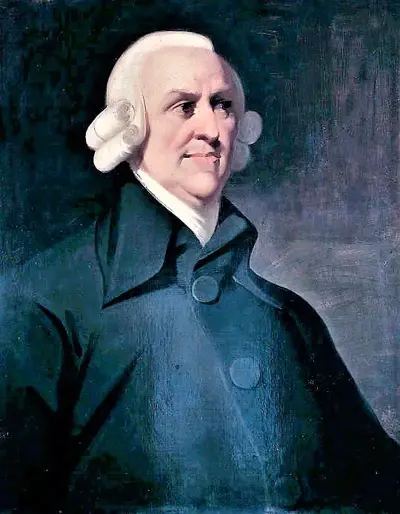
Adam Smith FRSA was a Scottish economist, philosopher as well as a moral philosopher, a pioneer of political economy, and a key figure during the Scottish Enlightenment, also known as ''The Father of Economics'' or ''The Father of Capitalism''. Smith wrote two classic works, The Theory of Moral Sentiments (1759) and An Inquiry into the Nature and Causes of the Wealth of Nations (1776). The latter, often abbreviated as The Wealth of Nations, is considered his magnum opus and the first modern work of economics. In his work, Adam Smith introduced his theory of absolute advantage.
