Gore Vidal Quotes
The Pentagon talks about our power to 'overkill' Russia ten times, twenty times, perhaps forty-eight times. For my tax money, it is sufficient to overkill them once.
Vidal, Gore. Matters of Fact and of Fiction: Essays 1973-1976. Random House, 1977, p. 250.


The President had asked for the views of the Joint Chief’s of Staff. At the time, the major U. S. defense doctrine depended on our nuclear deterrent which if used against the Russians would have meant mutually assured destruction since they had enough of a nuclear arsenal to destroy America as we know it.


A similar slogan, 'I'd rather be Red then dead,' was reported in Time, September 15, 1961.


Kennedy was then a Senator with an eye on the White House. No such missile gap existed, and when Kennedy was elected President, he had the problem of public expectation for a problem which did njot exist, but he had been instrumental in creating.


1st Earl Baldwin of Bewdley. Baldwin has been castigated since WWII for being part of the “appeasement group” in England. As Prime Minister in 1935 he would not face the threat of Fascism, Germany and the Nazis and did not initiate a major arms buildup. Churchill, among others, never forgave him. See {626930} for Churchill’s view of Baldwin.

As the atomic bomb evolved to the hydrogen bomb and the test results were learned by political and military leaders, the perception of the danger became much greater, especially when the Russians and French also developed their nuclear weapons. After that, and Einstein’s predictions about the cost and quantity, leaders in the world all became conscious of the danger of Mutually Assured Destruction (MAD), most leaders realized that it was impossible see atomic weapons as anything but defense.


The Scientific Project that developed the Atomic Bomb

He was exactly right. See {642079} for a perfect example of this prediction.


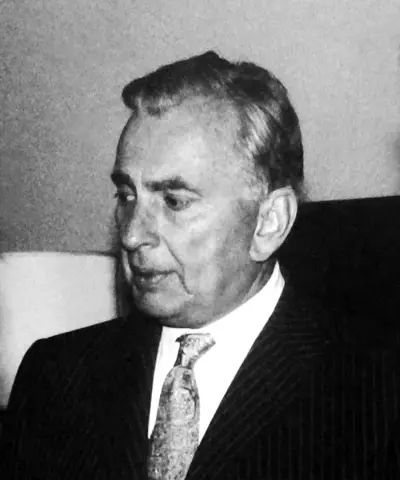
Eugene Luther Gore Vidal was an American writer and public intellectual known for his epigrammatic wit, patrician manner, and polished style of writing. Vidal was openly bisexual and his novels often dealt with LGBT characters, which was unusual at the time. Beyond literature, Vidal was heavily involved in politics. He twice sought office—unsuccessfully—as a Democratic Party candidate, first in 1960 to the United States House of Representatives (for New York), and later in 1982 to the U.S. Senate (for California).
