Albert Sidney Johnston Quotes
The Mormons have placed themselves in rebellion against the Union, and entertain the insane design of establishing a form of government thoroughly despotic and repugnant to our institutions.
The Mormons wanted Utah to be a United States territory or a state with an extreme state’s rights mentality whereby their religious doctrine in the Book of Mormon could be state law and at the time the Constitution had not yet been amended to require the state governments to adhere to the Bill of Rights or other Federal laws. In effect they wanted a democratic type of theocracy. See {619869}. The Mormons would not agree that Federal law should govern their community or people, and war with the Federal government was imminent. In an ironic twist, Johnson, a Texan, rebelled against the nation himself several years later when he became a Confederate General. He was the highest ranking Confederate Officer killed in Battle—at Shiloh.
Albert Sidney Johnston, 1803-1862, Commander of the U.S. Army Department of the Pacific, Commanding Officer of Federal Troops Sent to Utah, Report, November 1857
Sourced by: Eigen's Political and Historical Quotations


The use of “despotic” did not imply cruelty or even poor management of the society. The term was used to indicate that Brigham Young, the then Mormon Leader, had the powers and authority of a dictator. At the time most Americans in the East knew little about the Mormons. Ludlow was one of the early observers of Mormon society in Utah who wrote about the Mormons in popular—albeit intellectual—magazines. Ludlow regarded Mormonism as it was then practiced as incompatible with, and dangerous for, America, not because of the plural marriage, but the conflicts with the concepts of democracy and self-government. The authority that Brigham Young and the church then exercised over civil life was what distressed him and many other Americans.

Von Wackerbarth was one of the many Mormon haters of his day. His quotations have value not for the accuracy of the facts which are scant, but to indicate what much of public opinion regarding Mormons was in that day.

Federal officials and commissioners issued laws, directives and orders that were very unpopular with the Mormons who were in the overwhelming majority of the Utah territory. The Mormon “government” was a type of theocracy but a very popular one. The Mormons tried to test the constitutionality and legality of the Federal laws and orders before they would obey. The government position was that they should obey and then could test the laws in the courts. The Mormons eventually lost in the courts anyway, but the principle of obedience to law until it can be tested and reversed has generally been the rule of U. S. Law. However, civil disobedience in which many religions have engaged in our history argues the obverse. Eventually Taylor had to go “underground” and rule the church from exile in which state he died.

Lincoln was a deist but he was never a favorite of the official clergy of any of the religions. When he ran for President in 1860, 20 of the 23 clergymen of his home town, Springfield, IL, opposed him. As he assumed office he was much more prudent in his religious remarks and in the view of some historians political realities and pragmatics caused him to be more circumspect. His oldest friend and law partner believed him to be an unbeliever. See {586285}.

At the time Turkey and the Ottoman Empire included Egypt and most of the Middle East, Chechnya, Georgia, Armenia, Usbekistan, Ajerbaijon, Greece, Albania, Serbia, Bosnia, Croatia and other countries.


The major issue was whether Congress and the Federal Government could make laws and regulate the communities of people who had settled in the new territories. The argument that Young made was that unless a power was specifically enumerated in the Constitution as being granted to the Federal Government it was not. Most Constitutional scholars believe that there were powers implied by the enumerated powers such as the right for the Federal Government to regulate child labor or the safety of nuclear power plants which of course were never mentioned in the Constitution. At the same time anti Mormon sentiment led many to extend Federal Regulation to Mormons that had not been extended to other people. Plural marriage was one of those major value issues. The Mormons were very innovative in setting up institutions like buying cooperatives and systems for medical care and welfare, and many of these threatened the then established economic principles of many men of power and wealth. See {614881} for Brigham Young’s similar view.
Congress had passed the Edmunds Act prohibiting plural marriage. Taylor, who himself had 7 wives and 35 children, went “underground” and secretly operated the church from exile.

There was extensive persecution of Mormons with mobs denouncing them and attacking Mormon facilities and people often with the support of the government officials who were charged with protecting people and maintaining law and order.
The sermon was so stirring that it was published in Pittsburgh and distributed throughout the Union.

Five years earlier, Young had all but given up on the idea of converting Native Americans—see {619863} and {619863}. Young was very ambivalent about the Indians, at some points wanting to convert them and on others to have them removed from the area to make way for Mormon growth and development--{619865}. At this time, the Mormons and the Federal Government were at loggerheads regarding the requirement for enforcing Federal law in all territories including Utah. Young and others hoped to enlist Indian warriors in any potential battles with the army.
Von Wackerbarth was one of the many Mormon haters of his day. His quotations have value not for the accuracy of the facts which are scant, but to indicate what much of public opinion regarding Mormons was in that day.
In some countries political candidates run on religious platforms to convert the part of the population that is not of their religion and turn the nation into a theocracy.


First edition typo error -- dropped: "differences to a decision of them by an appeal to arms; to exclude foreign" Smith had written to most of the then likely Presidential candidates of both major parties asking for their position on the Mormons who were facing persecution wherever they went. None of the politicians would make any satisfactory commitments. Smith took Direct Action and became the only major religious official to have run for the Presidency of the United States until Pat Robertson tried and failed in 2000. Smith’s assassination shortly thereafter cut his run for the Presidency short before it made much headway and politically he had no chance to affect the race. In this platform he quoted and gave credit to Madison for many of the ideas.

Committee of the Congress. This was the prevailing Congressional and public view except for the South which had coalesced around an intellectual rationalization. See {618013}.
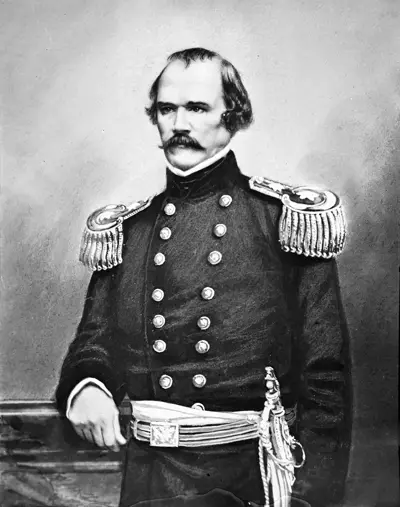
- Born: February 2, 1803
- Died: April 6, 1862
- Nationality:
- Profession:
Albert Sidney Johnston served as a general in three different armies: the Texian Army, the United States Army, and the Confederate States Army. He saw extensive combat during his 34-year military career, fighting actions in the Black Hawk War, the Texas War of Independence, the Mexican–American War, the Utah War, and the American Civil War.
