Brigham Young Quotes
It is a pretty bold stand for this people to take, to say that they will not be controlled by the corrupt administrators of our General Government. We will be controlled by them, if they will be controlled by the Constitution and laws; but they will not. Many of them do not care any more about the constitution and the laws that they make than they do about the laws of another nation.
Brigham Young, 1801-1877, Mormon Leader and Governor of Utah, Quoted in Latter Day Conservative Website, www.latterdayconservative.com, July 3, 2007
Sourced by: Eigen's Political and Historical Quotations

There was extensive persecution of Mormons with mobs denouncing them and attacking Mormon facilities and people often with the support of the government officials who were charged with protecting people and maintaining law and order.

The major issue was whether Congress and the Federal Government could make laws and regulate the communities of people who had settled in the new territories. The argument that Young made was that unless a power was specifically enumerated in the Constitution as being granted to the Federal Government it was not. Most Constitutional scholars believe that there were powers implied by the enumerated powers such as the right for the Federal Government to regulate child labor or the safety of nuclear power plants which of course were never mentioned in the Constitution. At the same time anti Mormon sentiment led many to extend Federal Regulation to Mormons that had not been extended to other people. Plural marriage was one of those major value issues. The Mormons were very innovative in setting up institutions like buying cooperatives and systems for medical care and welfare, and many of these threatened the then established economic principles of many men of power and wealth. See {614881} for Brigham Young’s similar view.
Statement regarding the situation the Mormons encountered where the majority of the citizens in the areas that they inhabited were not only opposed to Mormonism but felt it moral to attack, harass and even murder Mormons. Because the bigots were in the majority, the politicians and officials were loath to protect the Mormons. In Mormon religious prophesy, before the Second Coming of Christ the Mormons must settle in Zion and the Jews in Israel. So the persecution preventing them from settling in Zion was the work of Satan to prevent Christ’s coming.
Federal officials and commissioners issued laws, directives and orders that were very unpopular with the Mormons who were in the overwhelming majority of the Utah territory. The Mormon “government” was a type of theocracy but a very popular one. The Mormons tried to test the constitutionality and legality of the Federal laws and orders before they would obey. The government position was that they should obey and then could test the laws in the courts. The Mormons eventually lost in the courts anyway, but the principle of obedience to law until it can be tested and reversed has generally been the rule of U. S. Law. However, civil disobedience in which many religions have engaged in our history argues the obverse. Eventually Taylor had to go “underground” and rule the church from exile in which state he died.
The 100,000 Mormons in the Utah Territory rebelled at the hostile Federal officials coming into Utah to run things without the consent of the citizens of the territory. It was a cry for the territorial version of States’ Rights.

“Celestial Marriage” is the term then used be Mormons to describe plural marriage.
Congress had passed the Edmunds Act prohibiting plural marriage. Taylor, who himself had 7 wives and 35 children, went “underground” and secretly operated the church from exile.


In 1836 the House of Representatives adopted the so-called "Gag Rule" whereby the house could not act on all further petitions regarding slavery, even though thousands of petitions were being received. Adams was one of the few who protested the Gag Rule:. Adams even submitted petitions with which he did not agree:. Every year Adams attempted to get the Gag Rule repealed. He was even threatened with censure for his efforts, but his status as an ex-president protected him. Finally, in 1844, Adams' perennial resolution carried:

In the early 1900's there were major labor disputes between Colorado miners and the mine owners (the Colorado Mining Wars). Colorado Governor James H. Peabody ordered in a thousand troops under the command of Bell. Replying to the charge that his treatment of the miners was unconstitutional:


On the Fugitive Slave Act: As one of the leading American Catholic intellectuals during the 19th Century, Brownson’s opinions went far in keeping Catholics from joining the side of the abolitionists. However, just a few years later his tone would change and he would become one of the few Catholic writers to refuse to defend slavery, see {610710}. While the majority of Catholics refused to join the abolition movement, they often did so because abolitionism was closely tied to anti-Catholicism, see Gordon {611392} or Shaftesbury {611106}. Other reasons included Irish immigrants fearful of competition from Black labor and the fear of liberal individualism and social disorder, which was prevalent in 19th century Catholic thought. For a further explanation on the relationship between American Catholics and slavery, see McGreevy {612036}.

Though Ryan was not necessarily a proponent of Southern secession, he was an outspoken critic of the Lincoln administration’s misuse of Constitutional powers in the Civil War.
The major issue was whether Congress and the Federal Government could make laws and regulate the communities of people who had settled in the new territories. The argument that Young made was that unless a power was specifically enumerated in the Constitution as being granted to the Federal Government it was not. Most Constitutional scholars believe that there were powers implied by the enumerated powers such as the right for the Federal Government to regulate child labor or the safety of nuclear power plants which of course were never mentioned in the Constitution. At the same time anti Mormon sentiment led many to extend Federal Regulation to Mormons that had not been extended to other people/ Plural marriage was one of those major value issues. The Mormons were very innovative in setting up institutions like buying cooperatives and systems for medical care and welfare, and many of these threatened the then established economic principles of many men of power and wealth. See {614870} for John Taylor’s similar view.
Mormons were not only discriminated against but frequently robbed, murdered and ethnically cleansed from different parts of the country. In general the Federal Government did little or nothing regarding the plight of the Mormons.

Powell was the Secretary of State and Addington kept advising the administration that as long as the President was acting in defense of the country in his capacity as Commander in Chief, he did not have to obey any existing laws that had been Constitutionally passed which in the opinion of the President restricted or limited the President or the executive branch. Addington was an attorney and Assistant to the Vice President, but he was given much responsibility for administration policy. Powell the Secretary of State of the Administration could not have disagreed more and although most politicians including Republicans disagreed with the Addington thesis, Powell was one of the few Republicans to criticize the Addington position.
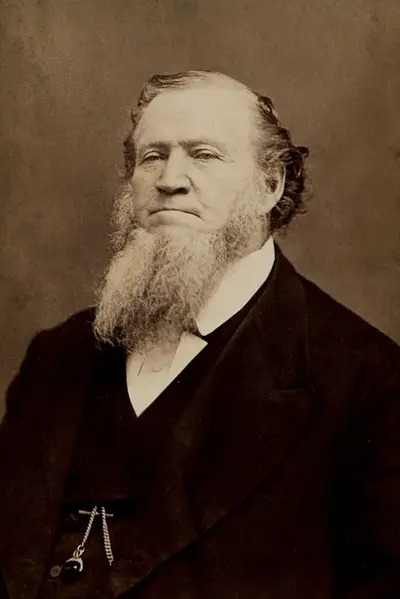
Brigham Young was an American religious leader, politician, and settler. He was the second president of The Church of Jesus Christ of Latter-day Saints (LDS Church) from 1847 until his death in 1877. He founded Salt Lake City and served as the first governor of the Utah Territory. Young also led the foundings of the precursors to the University of Utah and Brigham Young University.
