John Taylor Quotes
Concerning the course taken by the United States, they have a right to reject this law of Celestial Marriage themselves, as they have a right to reject the Gospel; but it is contrary to the provisions of the Constitution, which is the supreme law of the land, for them to prohibit you from obeying it.
“Celestial Marriage” is the term then used be Mormons to describe plural marriage.
John Taylor, 1808-1887, Mormon Apostle & Third President of The Church of Jesus Christ of Latter-day Saints, Official Statement to the Mormons on the Edmonds Act which prohibited plural marriage
Sourced by: Eigen's Political and Historical Quotations

The major issue was whether Congress and the Federal Government could make laws and regulate the communities of people who had settled in the new territories. The argument that Young made was that unless a power was specifically enumerated in the Constitution as being granted to the Federal Government it was not. Most Constitutional scholars believe that there were powers implied by the enumerated powers such as the right for the Federal Government to regulate child labor or the safety of nuclear power plants which of course were never mentioned in the Constitution. At the same time anti Mormon sentiment led many to extend Federal Regulation to Mormons that had not been extended to other people/ Plural marriage was one of those major value issues. The Mormons were very innovative in setting up institutions like buying cooperatives and systems for medical care and welfare, and many of these threatened the then established economic principles of many men of power and wealth. See {614870} for John Taylor’s similar view.

The 100,000 Mormons in the Utah Territory rebelled at the hostile Federal officials coming into Utah to run things without the consent of the citizens of the territory. It was a cry for the territorial version of States’ Rights.
The major issue was whether Congress and the Federal Government could make laws and regulate the communities of people who had settled in the new territories. The argument that Young made was that unless a power was specifically enumerated in the Constitution as being granted to the Federal Government it was not. Most Constitutional scholars believe that there were powers implied by the enumerated powers such as the right for the Federal Government to regulate child labor or the safety of nuclear power plants which of course were never mentioned in the Constitution. At the same time anti Mormon sentiment led many to extend Federal Regulation to Mormons that had not been extended to other people. Plural marriage was one of those major value issues. The Mormons were very innovative in setting up institutions like buying cooperatives and systems for medical care and welfare, and many of these threatened the then established economic principles of many men of power and wealth. See {614881} for Brigham Young’s similar view.
Congress had passed the Edmunds Act prohibiting plural marriage. Taylor, who himself had 7 wives and 35 children, went “underground” and secretly operated the church from exile.
Federal officials and commissioners issued laws, directives and orders that were very unpopular with the Mormons who were in the overwhelming majority of the Utah territory. The Mormon “government” was a type of theocracy but a very popular one. The Mormons tried to test the constitutionality and legality of the Federal laws and orders before they would obey. The government position was that they should obey and then could test the laws in the courts. The Mormons eventually lost in the courts anyway, but the principle of obedience to law until it can be tested and reversed has generally been the rule of U. S. Law. However, civil disobedience in which many religions have engaged in our history argues the obverse. Eventually Taylor had to go “underground” and rule the church from exile in which state he died.
There was extensive persecution of Mormons with mobs denouncing them and attacking Mormon facilities and people often with the support of the government officials who were charged with protecting people and maintaining law and order.

Young and the Mormons sent missionaries to many counties and made many converts. Since few countries provided a great deal of religious freedom, Young and other Mormons believed that God himself had created America with its freedom. Ironically, it was this advertising of America as a land of freedom that caused many Americans to discriminate against Mormons. The issue of Mormonism was conflated with a strong nativist and anti-immigrant sentiment that has existed among a part of the American population throughout its history. Many opposed the Mormons for the main reason that they were encouraging and in many cases aiding large numbers of immigrants to the United States.

Describes the contest between President Ulysses S. Grant and the Mormons over the issue of polygamy in the 1860s


In the wake of the Dred Scott Supreme Court decision, most Northern newspapers and leaders opposed the decision and argued against compliance—especially the Republican newspapers. However, some Northern newspapers were Democratic supporters and argued that the Supreme Court must be obeyed and to oppose the court is to oppose the Constitution itself.


Jackson was reacting to the claimed right of South Carolina to nullify Federal tariffs and other Federal laws.

Statement regarding the situation the Mormons encountered where the majority of the citizens in the areas that they inhabited were not only opposed to Mormonism but felt it moral to attack, harass and even murder Mormons. Because the bigots were in the majority, the politicians and officials were loath to protect the Mormons. In Mormon religious prophesy, before the Second Coming of Christ the Mormons must settle in Zion and the Jews in Israel. So the persecution preventing them from settling in Zion was the work of Satan to prevent Christ’s coming.
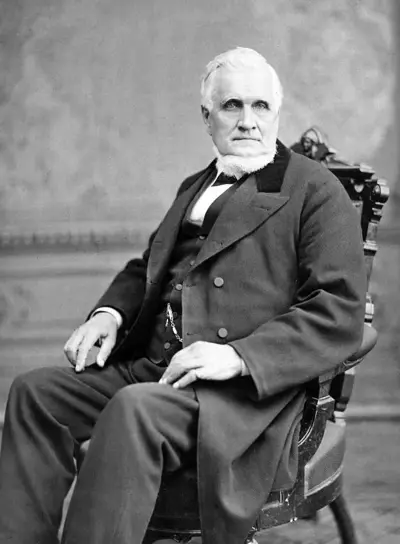
John Taylor was an English religious leader who served as the third president of The Church of Jesus Christ of Latter-day Saints (LDS Church) from 1880 to 1887. He is the first and so far only president of the LDS Church to have been born outside the United States.
