Rick Santorum Quotes
This right to privacy ... doesn't exist in my opinion in the United States Constitution, this right that was created, it was created in Griswold–Griswold was the contraceptive case–and abortion. And now we're just extending it out. And the further you extend it out, the more ...this freedom actually intervenes and affects the family. You say, 'Well, it's my individual freedom.' Yes, but it destroys the basic unit of our society because it condones behavior that's antithetical to strong healthy families. Whether it's polygamy, whether it's adultery, where it's sodomy, all of those things, are antithetical to a healthy, stable, traditional family.
Rick Santorum, U. S. Congressman & Senator (Republican, PA), Unsuccessful Candidate for the Republican Presidential Nomination, Interview with Associated Press, April 7, 2003
Sourced by: Eigen's Political and Historical Quotations


For the classic formulation, see Brandeis, Olmstead v. U.S., 1927


This is a classic example of taking a principle and extrapolating it to an absurd degree. The Supreme Court did rule that there was a right to privacy and did rule that the state could not interfere with most consensual sex in the home including adultery. However the court did not permit bigamy or polygamy, sex with minors, and a host of other areas where the common weal is benefitted. Santorum and others with his view believe that the state should have the right to criminalize adultery and homosexual contact in a private home. And they indeed had this prerogative at earlier times. People were jailed for adultery in Virginia, for having intercourse in different positions in Alabama, for using condoms in Connecticut and others. However, most of the support for these sexual control laws came from religious fundamentalists who wanted the state to enforce their religious beliefs on all. That together with the privacy right, no longer allowed these state abuses if individual freedom. Ironically, most of the advocates for the state’s having the right to restrict sexual freedom. Think of themselves as advocates of individuality and the government not telling folks what to do or how to behave.

Both the United States and Canada had laws regulating the sexual behavior of citizens in the privacy of their own homes. It was not just homosexuality that the state attempted to control. Even the specific positions and methods of heterosexual intercourse were controlled by some states. Oral sex, certain positions of intercourse and other “details” could put a person in jail. Canada, a parliamentary nation, changed this by legislation. In the United States, it was the Supreme Court decisions protecting privacy that invalidated these old sexual role restrictions and prescriptions. For example, just 4 years before this quotation was made, 1963, the state of Connecticut was ordered (Griswald v. Connecticut) to release a pharmacist for the “crime” of filling a doctor’s prescription for condoms for a married couple where the wife would likely die if she became pregnant and carried the baby to term.


He was referring to Eisenstadt v. Baird in which the court had just ruled on the quoted passage. Some opponents of the Court’s Roe v. Wade decision claim that the opinion came out of left field and had no logical chain from past jurisprudence, but as this quotation pointed out, Roe was the inevitable logical conclusion of an entire line of Supreme Court thinking. Opponents mostly sought reversal on fundamentally moral grounds, not legal.


The Grammar Curmudgeon


See {587703} for a similar statement by a Supreme Court Justice.

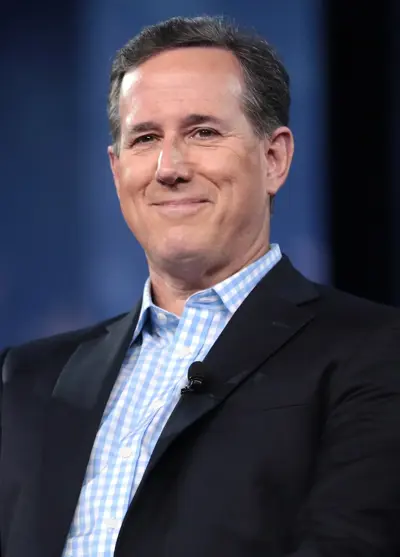
Richard John Santorum is an American politician, attorney and political commentator. A member of the Republican Party, he served as a United States Senator from Pennsylvania from 1995 to 2007 and was the Senate's third-ranking Republican from 2001 to 2007. Santorum ran for the 2012 Republican presidential nomination, finishing second to Mitt Romney. In January 2017, he became a CNN senior political commentator.
