Warren E. Burger Quotes
A right of privacy doesn't emerge from any single part of the Constitution. The right of privacy emerges from the Constitution as a whole.
Warren E. Burger, 1907-1995, Chief Justice of the U. S. Supreme Court, Interview, PBS MacNeil-Lehrer News Hour, September 13, 1990
Sourced by: Eigen's Political and Historical Quotations

For the classic formulation, see Brandeis, Olmstead v. U.S., 1927


Snowden, was a contract worker for Booz Allan assigned to the National Security Agency (NSA). He felt that some of the NSA activities were illegal and unethical and tried to complain to NSA officials who rebuffed him. Despite the fact that he had signed an agreement not to do so, he copied many critical, classified documents that exposed much of the NSA activities that the NSA officials had denied existed—including lying under oath to the Senate. He then made many of them public, violating his oath, breaking the law, and opening up an entire area of government spying which most Americans knew nothing about and about which senior government officials had lied under oath to Congress. They of course wanted to prosecute Snowden who had told the truth, while they had lied. For many Americans, this became a moral and ethical conundrum.


Powell was the Secretary of State and Addington kept advising the administration that as long as the President was acting in defense of the country in his capacity as Commander in Chief, he did not have to obey any existing laws that had been Constitutionally passed which in the opinion of the President restricted or limited the President or the executive branch. Addington was an attorney and Assistant to the Vice President, but he was given much responsibility for administration policy. Powell the Secretary of State of the Administration could not have disagreed more and although most politicians including Republicans disagreed with the Addington thesis, Powell was one of the few Republicans to criticize the Addington position.

This quotation is particularly important because it summarizes one of two opposite schools or thought regarding judicial interpretation of the Constitution that politicians have been arguing about since the Supreme Court first sat. The other is Original Intent where only the original intentions of the writers and ratifiers of the Constitution should be considered—assuming that it can be determined.


The FBI had obtained a court order requiring apple to write software that could hack into a person's iPhone. Apple, with most other hi-tech companies in support, filed a motion with the court opposing the order. The FBI shortly thereafter withdrew its request for the order saying that they had found other solutions, when they had originally told the court that there were no other solutions.


Many politicians were arguing that giving the intelligence agencies more power to wiretap, bug and hack into personal communications despite the 4th Amendment’s strictures argued that the public was in rational fear of terror attacks and had a right to be protected.


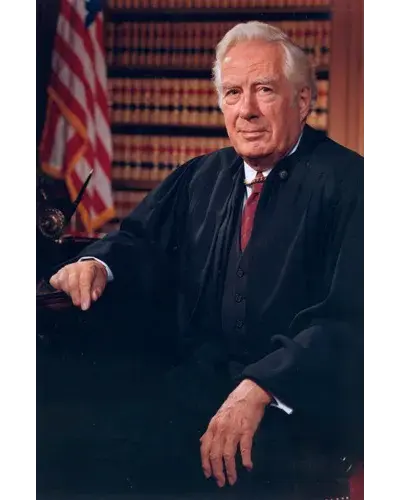
Warren Earl Burger was the 15th Chief Justice of the United States Supreme Court, serving from 1969 to 1986. Born in Saint Paul, Minnesota, Burger graduated from the St. Paul College of Law in 1931. He helped secure the Minnesota delegation's support for Dwight D. Eisenhower at the 1952 Republican National Convention. After Eisenhower won the 1952 presidential election, he appointed Burger to the position of Assistant Attorney General in charge of the Civil Division. In 1956, Eisenhower appointed Burger to the United States Court of Appeals for the District of Columbia Circuit. Burger served on this court until 1969 and became known as a critic of the Warren Court.
