James A. Garfield Quotes
The Mormon Church not only offends the moral sense of manhood by sanctioning polygamy, but prevents the administration of justice through ordinary instrumentalities of law. In my judgment it is the duty of Congress, while respecting to the uttermost the conscientious convictions and religious scruples of every citizen, to prohibit within its jurisdiction all criminal practices, especially of that class which destroy the family relations and endanger social order. Nor can any ecclesiastical organization be safely permitted to usurp in the smallest degree the functions and powers of the National Government.
The Mormon Church at that time allowed plural marriage. Men could have many wives. The Mormons—especially those who had moved to Utah—had organized many civic functions and performed much of the role that local and State governments did elsewhere in the country. The discrimination that Mormons faced in much of the nation was extreme including lynching and other physical attacks. So Mormons banded together in communities and their church became their local government. This together with the plural marriage offended many other Americans. The wall of separation of church and state was collapsing on many fronts with the Mormon Church assuming many governmental functions in Mormon areas and the Federal, State and local governments interfering with the personal and religious activities of the Mormons. This is one of the few occasions in American history where a President publicly criticized a religion in an official function. It took time and patience, but the issues were finally resolved, and discrimination against Mormons is rare, unusual and condemned by all levels of government and most Americans.
James A. Garfield, 1831-1881, 20th President of the United States (Republican, OH), Inaugural Address, March 4, 1881
Sourced by: Eigen's Political and Historical Quotations

There had been vicious discrimination against the Mormons as they migrated from New York State to Utah. Finally, when they reached a place where there were few others to harass them, the condition of the United States government was that they would have to surrender their religious practice of plural marriage. Twain and many others saw a total inconsistency between the monogamy demand and the freedom of religion with separation of church and state.


In 1896 Utah and the Mormon Church had banned polygamy, but U.S. Congressman, Brigham Roberts, 1857-1933, (Democrat, UT) had married three wives when polygamy had been legal. He refused to break his vows to his wives and leave two of them, and despite his election and almost a year of Congressional service, the House voted to exclude him. Grandfather of President John F. Kennedy

The church advised this to its members

While Pratt thought that his publication would explain Mormonism to the officials of the nation and reduce misunderstandings, the result was the opposite. Many Washington Government officials had heard “rumors” of Mormon polygamy. However, given their own perspective, most did not believe that any civilized people would so engage. But when they saw Pratt’s written documents like this, there was an official admission in writing of what was seen as a monstrous evil. Pratt himself had 7 wives and 45 children—shocking for most non Mormons of the time.

This was the decision that sanctioned anti-polygamy laws.


Note that the two do NOT ALWAYS coincide. There are those who argue that law should be respected, right or wrong. There are also those who argue that law should be respected, only when it is in the right. Note also that “respect” and “obedience” are two different things. Some people argue that law and the courts and government must have respect. Others that they are only due obedience but not necessarily respect when they are in the wrong. Still others, like Thoreau, that obedience even is not required when the law is wrong. There are those who take this to the degree that obedience to a “wrong” law is wrong and there is a DUTY to disobey a wrong law. However, a more nuanced view does not treat all laws as the same importance. I may think a particular tax is unjust and wrong, but obedience does not necessarily have moral consequences. A law that says that people with a certain religion must not be hired, however, is sufficiently immoral that I am obliged to disobey it.


Ms. Andrew Jackson’s divorce from her first husband was not done following all the legal requirements of the time. Technically, she was therefore a bigamist and an adulteress at the same time. While most Americans had no problem with this, there was then as there has been ever since a small, religiously driven, cultural conservative movement who objected to a President who was living with an adulteress in bigamy. Hammond was one of them. Just as Bill Clinton was very popular despite his sexual, moral transgressions, so was Jackson. However the conservatives of Washington DC made her life socially miserable.


Earlier {629154} Smith was much more sympathetic with slavery. His views evolved as you can see by the comparison. He stated that he had a vision and made two prophesies {629156} that indeed came true. The last idea of slave buyouts seemed plausible to many abolitionists initially when they were not really knowledgeable about the economics of slavery. However, once they studied it, it became clear what it would not work even if the Southerners would then be willing to accept Blacks as free laborers which most were not, The two biggest problems were: 1) the international slave trade had been abolished. The only source of new slaves for growth was breeding them. Therefore, having slaves had TWO economic values—the work that they could do and the reproduction of themselves. A critical mass of owned slaves produced an income forever. And for Southerners who were culturally adverse to work (see {629169}), just having cash for their slaves was not enough. They were the servants, the farm labor, and their recreational sex. 2) and most important, the value or the slaves of the South was greater than the economic value of all the land, all the farms, all the buildings, all the factories, and all the inventory of the stores of the South all put together. The Southern slaves were the majority of the wealth of the south. There was no asset that could ever produce enough value to pay for the slaves—even over time. It would be like trying to buy all the shares of all the corporations in America today. There is no asset big enough to raise the money to ever finance it. The idea may have worked in Colonial America or even prior to the outlaw of the international slave trade, but by the time anyone took the idea seriously it was economically no longer feasible.


This is one of the major reasons that the relations between police and the communities they are policing is so important. Also, the style and courtesy that the IRS tax collectors exhibit is very important.


Second to Benjamin Franklin, Rush was the only other real scientist of the American colonial era. Franklin was not much of an enthusiast for religion. Rush was.


The mint released newly minted $10 and $20 gold coins designed by Augustus Saint-Gaudens,igenerally considered the most beautiful coins ever minted. But the words “In God We Trust” were deleted. There had never been any law passed by Congress authorizing such and many felt that such wording is unconstitutional. It was however a custom.


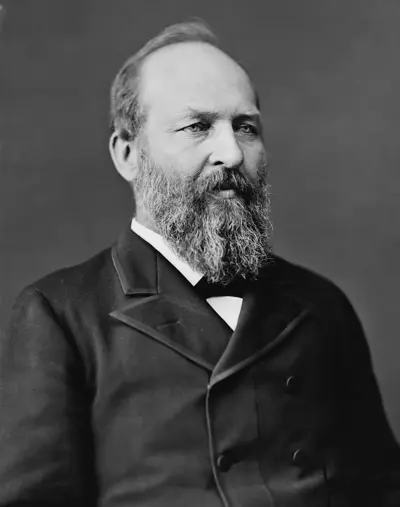
James Abram Garfield was the 20th president of the United States, serving from March to September 1881. Garfield was shot by an assassin four months into his presidency and died two months later. He is the only sitting member of the United States House of Representatives to be elected to the presidency.
