Stephen F. Austin Quotes
The men now in power in this state [Texas] wish to tolerate slavery
Under the Mexican law which governed Texas at the time, slavery had been much curtailed. Austin and many others wished to expand it “to permit families to bring the necessary and indispensable house servants and laborers”
Stephen F. Austin, 1793-1836, Founder of the State of Texas, Letter to Wharton, 1829
Sourced by: Eigen's Political and Historical Quotations


Brown was the richest man in Rhode Island and made much of his money in the slave trade. This quotation shows that slavery was not completely a North verses South split. Northerners like Brown for whose family Brown University was named, was as virulent supporter of slavery as the most ardent Southerner.

The Emancipation Proclamation was issued by the commander in chief as a wartime necessity. Any future President could undo that proclamation. However, the 13th Amendment outlawed slavery forever regardless of the desires of the Congress, Presidents, or State governments.


Moss and two other blacks had had the temerity to open a grocery store. White competitors attempted to have the city authorities close the store. When that failed, a mob took the three Black owners to the city limits and shot them all to death. Moss was a close friend of Ida B. Wells, and his lynching started her on her no famous anti-lynching expose and campaign. See {44393} for her initial response.

The issue of slavery which had been suppressed in Congress for the first decades of the nation broke out when Missouri statehood was considered. By previous agreement, slavery was not even discussed in Congress but the time period elapsed. Tallmadge not only proposed that no more slaves could come into Missouri {613176} but most shocking to the Southerners was that every person born in the new state would be free at the age of 25. In a generation, there would be no more slavery in Missouri and there would be no economic compensation for slave owners at all. The House of Representatives accepted the amendment, but it failed in the Senate. At that time, Senators were not elected by voters but were appointed by the state legislators and the Southern slave states had a disproportionate share of the senate from a population point of view. But what this quotation shows clearly that a majority of the country in 1819 were opposed to slavery and were willing to end it without compensation.

The “stake” refers to burning at the stake, one of the methods of murder used in the South to intimidate Negroes and whites who might hold anti-slavery sentiments.

This quotation, one of William Lloyd Garrison’s favorite quotations illustrating the intellectual degeneration brought about by slavery. In historical perspective, Lumpkin, later, was one of the three justices of the Georgia Supreme Court, and with this kind of intellectual and legal corruption the Courts of the South were major forces protecting the institution of slavery.

A few years later he had a clearer idea of what was to be done. However, the additional factor of the Civil War played a big part in driving his Emancipation Proclamation. See {609360}

His solution was not to change the prejudice or improve the opportunity for Blacks but to have complete separation of the races. See {625687}.

Parker and other escaped slaves in Christiana fought off slave catchers and killed the slave owner leading them. Charged with treason, he escaped to Canada with his family and lived there the rest of his life. While not a polished writer, after he himself had escaped and went to Christiana and leaned to read and write. He wrote this narrative of his life as a slave—one of the few written works we have from slaves.
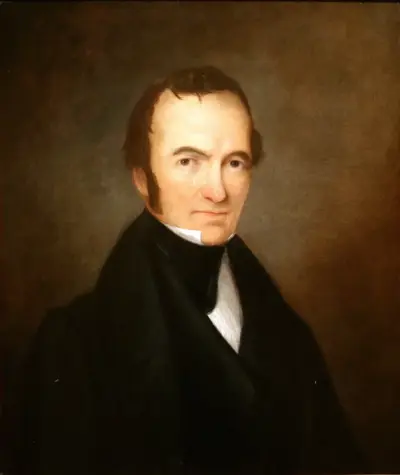
Stephen Fuller Austin was an American-born empresario. Known as the "Father of Texas" and the founder of Anglo Texas, he led the second and, ultimately, the successful colonization of the region by bringing 300 families from the United States to the region in 1825.
