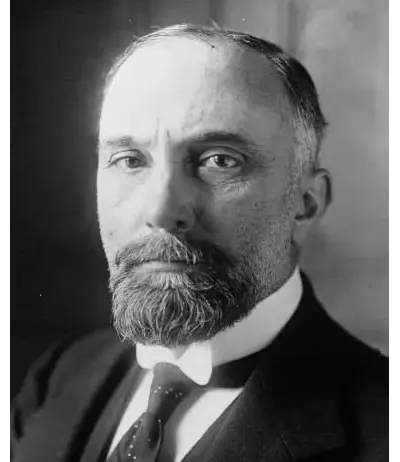
Carlo Sforza Quotes
The landed proprietors as a class are little qualified to pass judgment as to the real and the fictitious in certain social phenomena; on the other hand, they are naturally inclined to follow any conservative tendency, afraid as they are of a return of serious disorders .... The great industrialists were not thinking of combatting Bolshevism, which they knew very well did not threaten them any longer; they were up in arms against the socialist, or socializing, spirit of reform which had been gradually developing in the first twenty years of this century
Carlo Sforza, 1872–1952, Foreign Minister of Italy, Anti-Fascist Italian Leader, “Italy and Fascism”, Foreign Affairs, April 1925
Sourced by: Eigen's Political and Historical Quotations

The Fascists had been in control of the Italian government for 4 years.


Opposition to the Bolsheviks

This is a particularly important quotation. The American Socialists were very clear as to what Socialism was and what it was not. One of the favorite and successful tactics of Conservatives in America was to label any reform that they were opposed to as Socialist or Communist during the Red Scare. 100 years after this was published, the same technique was used. When Barack Obama was elected President, the Republican opposition to most of his reforms almost always began with the accusation that the reform was Socialist and many of the conservatives called Obama himself a Socialist. They had head the term applied to anything progressive for so long that they didn’t really know what Socialism was. This quotation makes it very clear. The “Night Riders” were the KKK and others who would lynch, murder and torture Blacks. The favorite claim of Southern segregationists was that any attempt at ending segregation was Socialist or Communist. That worked until the passage of the 1963 Civil Rights Act.

After the 1917 Russian Revolution many of the Western Countries sent troops to Russia where they aided the Whites against the Reds. When the Red Bolsheviks prevailed, there were many attempts to diplomatically and economically undermine the Communist government. This caused a unity among different Russian factions. Sforza urged leaving them alone and letting the Bolsheviks fail by their own ideology. Most Western nations and the United States did not agree with him.

After Roosevelt, most eras of American politics more or less followed the pattern Roosevelt described herein as a “calamity”, with the anger becoming more or less intense. Jefferson thought that these were natural divisions of politics in all societies--{604810}. The thing that masked this for years was race and slavery. In Lincoln’s time there were liberals and conservatives in both parties if race were ignored. In Theodore Roosevelt’s era, he, Taft and others were generally liberal reformers, while a large number of Republicans were conservative supporters of the status quo. Some democrats were radical reformers like William Jennings Bryan while others were arch conservatives. Until 1964 and the Civil Rights Act there were many conservatives in the Democratic Party, but almost all switched to the Republican Party in anger. The Republican conservatives tended to drive the Republican liberals out of the party and for the last part of the 20th century Roosevelt’s “calamity” well described the American political scene, and the anger increased carrying partisan bitterness into the 21st century.


The “rebate agony” referred to a corrupt practice of the Railroads and the Large Monopolies. The railroads charged a very high rate for the transportation of important products like beef and oil. However, secretly they gave back a large percentage of the transportation rate charged to the trusts. They in turn could cut their prices and undersell all the smaller competitors who were paying “full freight” and could not afford to match the lower price. As soon as the smaller competitors were driven out of business in an area, the trust raised its rates even higher than they charged originally. The Railroad had made a small but reasonable profit on the freight of the trusts but they were guaranteed all their business. They also made huge profits on the higher rates that the small companies paid until those companies were driven out of business. Journalists like Ray Baker and Ida Tarbell had uncovered the rebate scheme which enabled the trusts to steal high amounts from the general public through unreasonably high prices. President Theodore Roosevelt was committed to try and regulate the railroads and not allow rebates but charge the same public rate to all with no rebates. Socialists like Sinclair, thought that this attempt would be hopeless—that the damage had already been done, and the trusts now had so much money that they could buy state legislatures and many in Congress to preserve their dominance.


He was a strong foe of both Communism and Capitalism. He was one of the first critics to describe the de facto inequality of Communism.