Karl Marx Quotes
You are horrified at our intending to do away with private property. But in your existing society, private property is already done away with for nine tenths of the population; its existence for the few is solely due to its non-existence in the hands of those nine tenths. You reproach us, therefore, with intending to do away with a form of property, the necessary condition for whose existence is the non-existence of any property for the immense majority of society.
Marx, Karl, and Friedrich Engels. Manifesto of the Communist Party. Translated by Samuel Moore, Charles H. Kerr & Company, 1906, p. 39.


The issue of public or private ownership and control of technology is not only a product of the information age where equal access to computers, the Internet were argued as a political necessity. But there were those who made the same argument a century earlier about the new technology of the times—machines.


Alexander Dubcek, Communist leader of Czechoslovakia, had pushed reform so far that 5 Soviet armies invaded. Dubcek was brought to Russia where he tried to persuade the Russian premier that the invasion was contrary to the principles of socialism.


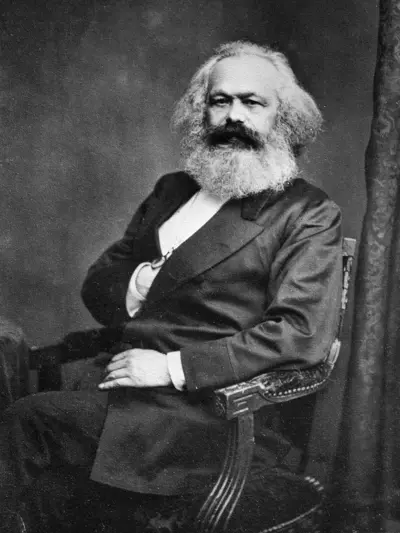
Karl Heinrich Marx was a German philosopher, economist, historian, sociologist, political theorist, journalist and socialist revolutionary. Born in Trier, Germany, Marx studied law and philosophy at university. He married Jenny von Westphalen in 1843. Due to his political publications, Marx became stateless and lived in exile with his wife and children in London for decades, where he continued to develop his thought in collaboration with German thinker Friedrich Engels and publish his writings, researching in the reading room of the British Museum. His best-known titles are the 1848 pamphlet The Communist Manifesto and the three-volume Das Kapital (1867–1883). Marx's political and philosophical thought had enormous influence on subsequent intellectual, economic and political history. His name has been used as an adjective, a noun, and a school of social theory.
