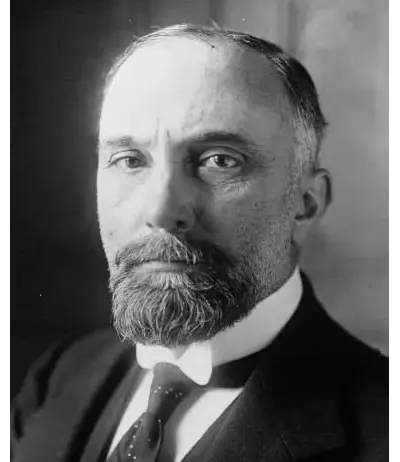
Carlo Sforza Quotes
What is certain is that today, though many great land owners still favor Fascism--which is only natural because the agricultural classes are always the slowest to change--captains of industry have already expressed through their authoritative spokesmen the opinion that Fascist excesses in the way of political reaction and repression of the workers represent a grave danger for the industrial classes.
The Fascists had been in control of the Italian government for 4 years.
Carlo Sforza, 1872–1952, Foreign Minister of Italy, Anti-Fascist Italian Leader, “Italy and Fascism”, Foreign Affairs, April 1925
Sourced by: Eigen's Political and Historical Quotations

Mussolini and the Fascist majority had already gotten control of the government but their hold was then precarious.

There were massive strikes in Italy. These strikes began in the engineering factories and soon spread to railways, road transport, and other industries. The strikers, however, did more than just occupy their workplaces, they seized them for themselves. Soon 500,000 strikers were at work, producing for themselves. The question was what next. Malatesta and others recommended that they go on and take over the government and not just try and have better labor conditions and factory operations. See {616350}. He warned that the capitalists and middle class bourgeoisie had been so frightened by the successful national strike that they would even ally with the Fascists who they did not like either. That is how Mussolini and his Fascists came to power.


Executed by the English for his part in the Easter Uprising. Connolly was a socialist advocate as well as a republican. He was one of the first revolutionaries to understand that military occupation was only a part of forces that kept a nation subservient to another. However, attempts to break those economic ties have almost always led to economic ruination.

There were many British and American capitalists, like Lindbergh, who were great admirers of Hitler and Mussolini and supported the Fascists.

Over the years, despite many efforts to unify workers of the world, most were much more focused on their own country. In this sense, Mussolini who was so wrong about most political things, may have been right in this instance.


This memo was written a few days before his death and it was the last document he wrote. The communists tended to use the word “socialist” so they could make it seem that the Soviet Bloc was allied or part of the same grouping as the Scandinavian countries, India and other countries that were neither ideological communists nor controlled by the Russian or any other Communist Party. Those nations, in contrast tended to use the word, “socialist” to distinguish themselves from the Communist countries. This mostly confused many Americans. Some conflated the socialist countries and the communist countries making no distinctions. Others, like most European politicians kept the distinction in mind. Most Americans were confused as the Red Scare perpetrators tended to conflate, and the liberals tended to distinguish.


Vladimir Lenin. Most did not and the Communist government was brutal and murderous in forcing them into the Communist culture, outlook, and behavior. See {640096} for a description of some of the effort.
Vladimir Lenin. One of the claimed benefits of Capital Punishment has always been the inhibition of others, but it turned out that it was never very effective at that. However, prevention was Lenin’s major objective so he ordered public hanging instead of shooting—the usual method of execution at the time. This infamous quotation started the new Russian government off on a horrible record of civil and human rights. The people hanged were not particularly guilty of any crime. They were just people who had gotten, or whose family was, rich under the Czar. The disregard for rule of law was most dramatically evidenced by this Lenin order. Needless to say, rich people the world over, saw a great threat to their lives from this new state wanting to export its philosophy.
He was describing the Russian peasant in the aftermath of the Russian Revolution, however it applied to the peasants of many countries of Europe. He was explaining why the Communist revolutionary government in Russia was not getting enthusiastic cooperation from the peasants when the government was trying to “help” them. Immediately after the Russian Revolution, the provisional government appointed him as Ambassador to the United States. However, the provisional government was supplanted when the Bolsheviks took over. Not enamored of Communism, he stayed in the United States with many other Russian refugees.

His prediction was accurate and the consequence was an increase in the production of agricultural products and a shrinking proportion of Americans employed in farming and ranching.
Zenzinov was often a critic of the Bolsheviks.
Mussolini and the Fascists had been in government for 4 years at this point.