Salmon P. Chase Quotes
The judicial cannot prescribe to the legislative departments of the government limitations upon exercise of its acknowledged powers. The power to tax may be exercised oppressively on persons, but the responsibility … not to the courts, but to the people by whom its members are elected.
Salmon P. Chase, 1808-1873, U. S. Senator (Free-Soil & Republican, OH), Ohio Governor (Free-Soil), U. S. Secretary of the Treasury, Chief Justice, U. S. Supreme Court, Veazie Bank vs. Fenno, 1869
Sourced by: Eigen's Political and Historical Quotations


Marshall is famous for, as Chief Justice, establishing the principle that the Judiciary can override Congress and the Executive in determining Constitutionality. However, as this quotation illustrates this principle had been discussed in open debate on the ratification of the Constitution. It was not simply a grab for power by a Chief justice; he uttered this quotation long before he ever suspected he would be a judge but actually spent much of his career in the executive and legislative branch of government.


In 1628 Parliament, in response to abuses by King Charles I, was about to pass The Petition of Rights–-a type of Bill of Rights. The King gave assurances that the practices—such as forcing nobles to lend him money—would not continue and didn't want to be embarrassed by passage of a law which he claimed would indicate that the Parliament did not trust him and weaken the dignity of the monarchy. The Petition of Rights passed with Cole’s leadership.

President Abraham Lincoln had pocket vetoed his own party's reconstruction bill in the midst of an election year.


Jefferson’s fears were later reinforced by John Marshall in Marbury v. Madison {606468}


At the time the power and prestige of Congress relative to the Presidency , was much greater than it is today. It was McKinley’s successor, Theodore Roosevelt, who began a 20th century trend which led to a reversal of the relationship between the Executive Branch and the Legislative.

Some of the Founding Fathers did not conceive of the kind of judiciary where Federal courts could nullify an act of the Congress by declaring a law unconstitutional. Morris was one. Others did. The Constitution is not very explicit on this point, but the nation has settled with a process that would have surprised Morris and a few others.
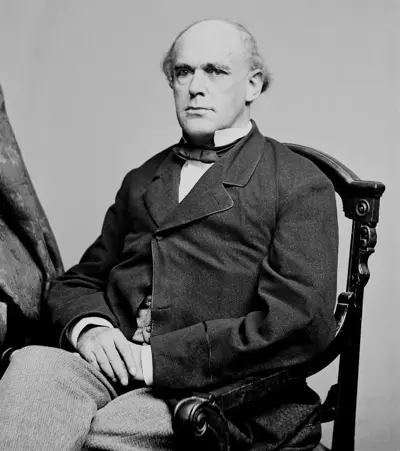
Salmon Portland Chase was a U.S. politician and jurist who served as the sixth Chief Justice of the United States. He also served as the 23rd Governor of Ohio, represented Ohio in the United States Senate, and served as the 25th United States Secretary of the Treasury. Chase was therefore one of a few U.S. politicians who served in all three branches of the federal government.
