John Ruskin Quotes
The great cry that rises from all our manufacturing cities, louder than the furnace blast, is all in very deed for this -- that we manufacture everything there except men.
Ruskin, John. The Stones of Venice. Vol. 2, Smith, Elder and Co., 1853, p. 165.


Fortunately for America, Jefferson did not get his wish. Jefferson did mellow on this point as he got older. See {606440} for a related quotation 27 years later.

He was describing England before the Industrial Revolution. The manufacturer / artisan owned his own home and had a small garden. He was not paid very well, but if business was slow his family could subsist by growing his own food and animals. With the Industrial Revolution came specialization as well as mechanization. If business was bad hundreds or thousands of workers had no way to make a living.


One steam engine, pulling a large plow by cables and manned by 5 or 6 workers could do the work of 20 horse drawn plows each requiring 1 worker. In addition all the workers who were needed to maintain the horses and clean up after them were also no longer required.


Spengler and some others viewed with alarm the urban migration that had come with the industrial revolution. That migration was relatively minor compared to what took place in the remainder of the 20th century. In most developed coutries the rural population has become very small and the urban and suburban totally dominant.

Julius Jacob von Haynau, 1786–1853, was a vicious Austrian General who had committed many atrocities in Italy and Hungary which today would be considered War Crimes and Crimes Against Humanity. He even had women publicly flogged who were heard saying anything sympathetic about the freedom fighters who the General suppressed brutally. Haynau was known and despised by military men the world over. So many of the Confederate and Union officers understood the insult. General Butler was not accused of atrocities of the usual type, but as the Commanding Union General of New Orleans, he was not very chivalrous to the Southern women of the city who were particularly effective in harassing the Union Officers and men. For example, the women would store the urine and feces of the chamber pots of the house and wait until Union soldiers, preferably officers, walked by and unloaded the waste on them from upper story windows. Butler ordered that women who harassed the soldiers could be “treated like common prostitutes.” Butler also turned a blind eye to the looting of the activist women’s silver and other valuables.
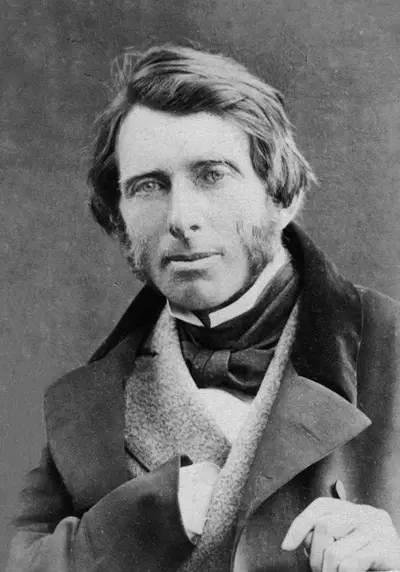
John Ruskin was the leading English art critic of the Victorian era, as well as an art patron, draughtsman, watercolourist, philosopher, prominent social thinker and philanthropist. He wrote on subjects as varied as geology, architecture, myth, ornithology, literature, education, botany and political economy.
