Carl Sandburg Quotes
Hog butcher for the world, Tool maker, stacker of wheat, Player with railroads and the nation's freight handler; Stormy, husky, brawling, City of big shoulders.
Carl Sandburg, 1878-1967, Poet and political biographer, "Chicago," 1916
Sourced by: Eigen's Political and Historical Quotations


The great cities of the world have more in common with each other than they do with other not so sophisticated cities in their own country. They tend to have concentrations of talent, culture, educational institutions, capital, services, museums, with excellent infrastructure of transportation, entertainment, and above all diversity for the individual and a wide multiplicity of choice.

Fortunately for America, Jefferson did not get his wish. Jefferson did mellow on this point as he got older. See {606440} for a related quotation 27 years later.

One steam engine, pulling a large plow by cables and manned by 5 or 6 workers could do the work of 20 horse drawn plows each requiring 1 worker. In addition all the workers who were needed to maintain the horses and clean up after them were also no longer required.


Arguing that Slavery inhibited a society from development ...


In Jefferson’s time most people aspired to acquire some land, and have their own home and farm on it. Immigrants come to the cities and worked to make enough money to go somewhere else and acquire some land to create a farm. However, over the last 100 years, the economy and human aspirations have changed. People are leaving the land and the farms to look for non-agricultural work and cities are expanding all over the world while rural area populations are declining. While undeveloped societies still have land reform pressure, industrial democracies have little pressure for individual ownership of land except to place a home on. Acreage for farming and ranching is no longer desirable for most people. In the United States, there are millions of acres of undeveloped land that can be purchased very cheaply as few people want to start farms or ranches any more. Alexander Hamilton’s vision of the American Economy has come to pass and not Jefferson’s.


Earlier, Jefferson was opposed to manufacturing in America as factories were a social blight in Europe which he wanted to keep out of the United States. He felt that we could import whatever we needed from Europe and not have the evils of industrialization. However, with the War of 1812, the Barbary Pirates and his mellowing when no longer President, and his willingness to change his positions as he learned more, he issued this letter. See another the following year: {615634}. His was considered such an important change of position—today we would accuse him of a flip flop— that other journals and periodicals reprinted the letter and commented upon his change. Despite his changed position, most Americans believe that Jefferson was opposed to manufacturing and industrialization for his entire life—not just the first part.


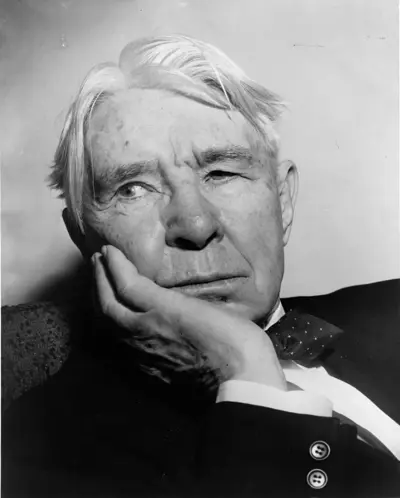
Carl August Sandburg (January 6, 1878 – July 22, 1967) was an American poet, biographer, journalist, and editor. He won three Pulitzer Prizes: two for his poetry and one for his biography of Abraham Lincoln. During his lifetime, Sandburg was widely regarded as "a major figure in contemporary literature", especially for volumes of his collected verse, including Chicago Poems (1916), Cornhuskers (1918), and Smoke and Steel (1920). He enjoyed "unrivaled appeal as a poet in his day, perhaps because the breadth of his experiences connected him with so many strands of American life", and at his death in 1967, President Lyndon B. Johnson observed that "Carl Sandburg was more than the voice of America, more than the poet of its strength and genius. He was America."
