John Steinbeck Quotes
The new American finds his challenge and his love in the traffic-choked streets, skies nested in smog, choking with the acids of industry, the screech of rubber and houses leashed in against one another while the townlets wither a time and die. This is not offered in criticism but only as observation. And I am sure that, as all pendulums reverse their swing, so eventually will the swollen cities rupture like dehiscent wombs and disperse their children back to the countryside.
John Steinbeck, 1864-1946, Nobel Laureate in Literature, Travels With Charley: In Search of America, 1962
Sourced by: Eigen's Political and Historical Quotations

Spengler and some others viewed with alarm the urban migration that had come with the industrial revolution. That migration was relatively minor compared to what took place in the remainder of the 20th century. In most developed coutries the rural population has become very small and the urban and suburban totally dominant.


In most of the world there has been a continual migration into cities.


See {621891} for a similar view.


His studies showed that at the end of the 10th Century, London was booming. At that time the diet changed rapidly from fresh water fish to salt water fish. The economic boom and growth placed heavy demand on the fresh water fish stock which had become depleted. Londoners then turned to the ocean for their fish. Now the oceans are becoming depleted of fish stocks, and the next step is likely to be large scale fish farming.


Western populists were terribly suspicious of the cities. Note that the migration to cities was noticeable enough to be considered a problem. Better roads and the railroads made relocation easier.

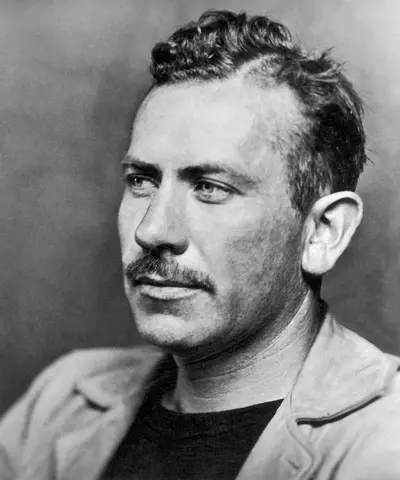
John Ernst Steinbeck Jr. was an American author and the 1962 Nobel Prize in Literature winner "for his realistic and imaginative writings, combining as they do sympathetic humour and keen social perception." He has been called "a giant of American letters," and many of his works are considered classics of Western literature.
