George S. Patton Quotes
The fatalism attributable to the Koranic law may well be the basis for Mohammedan decadence. If the man is unsuccessful, he does not look to himself. It is the will of Allah. If the murder was committed, that’s who was preordained. It is the same with sickness; it is the same with everything -- it is Kismet!
Patton was leading troops in north Africa in world war two. They came into much contact with the Arabs and Patton thought that his officers should know more about them. He wrote this memo.
George S. Patton, 1885-1945, U.S. Army General, “Notes on the Arab”, Memorandum, January, 1943
Sourced by: Eigen's Political and Historical Quotations

Charles was a young man who ruled under the thumb of his mother, Catherine de Medici. She and the leading Catholic political figures had decided to have the army massacre the Huguenots—Protestants—of France. Charles knew the massacre was to begin that night and tried to save his friend Rochefoucault, a Protestant, who was a member of the King’s court. He suggested several times that Rochefoucault not go home that evening but stay at the Louvre. The unsuspecting Rochefoucault felt that he had to get home to his wife and left explaining that to the King. Hence the King’s remark. Rochefoucault and his family were murdered that night. In the end, 50,000 Protestants were massacred in what has come to be known as the Massacre of Saint Bartholomew. Many of the palace servants were Protestants and were cut to ribbons throughout the palace. The King from a palace window shot a rifle at Protestants trying to swim the River Seine to escape, while his page kept reloading for him.

Hizb ut-Tahrir is a “worldwide Islamic political party.” It is banned as a terrorist, violence provoking institution in most of the Muslim countries and many nations in Europe.

The “People of the Book” are the Jews and the Christians who believe in the Old Testament book of God which Muslims recognize. Others who would not accept Islam would be killed, but if Jews and Christians are submissive and fell so, they may pay a special additional tax, the Jizyah.
Fundamentalist Christians and Jews believe that the Bible is the revealed word of God. In Islam, not only is the same position taken, but it is specifically forbidden to even think about or have a personal opinion about a matter which appears in the Koran—decided by Allah and revealed to the Prophet Muhammed.

This is another of De Tocqueville’s prescient statements that in retrospect seem so amazing given the time. This quotation could serve as an op ed in a newspaper of any of the industrial democracies of the early 21st century. However, he did not have the information of the details we have today that showed Islam as the pinnacle of scientific, philosophical, literary and medical achievement at the beginning of the second millennium, while the Christian nations of Europe were mired in the Dark Ages. It was the same Koran but a very different interpretation and framework that led to the decadence while it was the Protestant Reformation that triggered a Christianity that was hospitable to modernity and enlightenment.
What makes this quotation very notable is the fact that Dr. El-Naggar is not even a cleric but a scientist. and yet in spite of his education, much broader than most Muslim men, he still thinks of the Koran as the only source of truth available to man. Observation, deduction, induction, experimentation all have no weight. Herein lies one basic difference between Islamic Fundamentalists on the one hand and Christian, Jewish, Hindu & Buddhist and other religion’s fundamentalists. All may accept their holy book as the revealed truth, but it is only the fundamentalist Muslim who believes that it is the ONLY source of truth and wisdom. A classic difference between the radical fundamentalist and the moderates is that moderates, like almost all religious people on earth, believe that there are other sources of knowledge, truth and wisdom besides their holy book.
Ibn Rushd is generally considered the greatest of the Islamic philosophers. In this famous quotation he observes that the Koran is contradictory when it addresses issues of determinism and free will, a subject inquired about in most religions philosophies. While the same thing can be said of the Bible, what surprises some, is that a great Islamic scholar could say that there were contradictions in the Koran as many think of Islam as requiring literal adherence to and faith in the validity of the Koran. Contradictions are not admitted as possible. It illustrates that not all Islamic scholars are fundamentalists, but also that the leading Islamic scholars of the 12th century could hold such a view and freely publish it. Such ideas might get one killed in fundamentalist parts of Pakistan or Saudi Arabia today. Although valid for Muslims, the Hadith is less well known than the Koran which is recited by all good Muslims.


This is one of the early calls for a partition of India which was to be so disastrous after the Second World War. The “free Muslim state of states” turned out to be Pakistan where they have been fighting amongst themselves about how much Sharia would prevail.
This is not terribly different however from Christians and Jews selectively quoting the Bible.

This is a very important point as most Muslims believe that the actual wording of the Sharia—Islamic Law—comes from the Prophet directly and are not the words of various legal scholars which is just what they are. Needless to say, there are many differences and even contradictions depending on time and the particular scholar. Islam however has no authority that religiously is higher than any other. In that respect, it is like Judaism. There is not a recognized religious hierarchy as there is in Christian churches.


The Manual was found by the Manchester (England) Metropolitan Police during a search of an Al Qaida member's home.


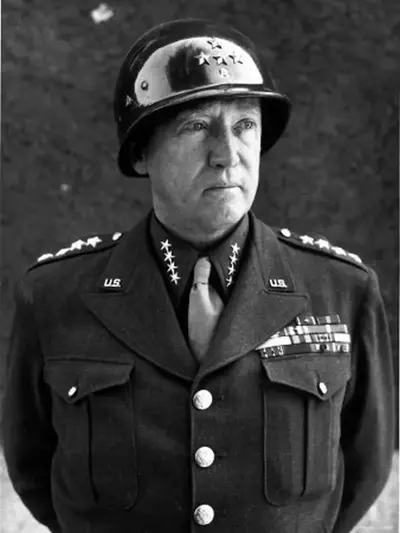
George Smith Patton Jr. was a general in the United States Army who commanded the Seventh United States Army in the Mediterranean theater of World War II, and the Third United States Army in France and Germany after the Allied invasion of Normandy in June 1944.
