Stephen III Quotes
… the faithless and most vile Lombard people … whose members have certainly brought forth the lepers.
The papacy and the Lombards were in a dispute over control of various land holdings. The Pope assumed that leprosy was wrought by God to evil people and in his view the Lombards were that so they would definitely have leprosy.
Stephen III, ~720–772, Roman Catholic Pope, Quoted in Becher, Charlemagne
Sourced by: Eigen's Political and Historical Quotations

Marshall was one of the greatest soldiers who ever served America. He was the Chief of Staff throughout the Second World War and then served as Secretary of State. It was he who devised and implemented the Marshall Plan. McCarthy accused thousands of people of being disloyal including Marshall. He claimed to have lists of communists in the Army and other agencies of government, but never produced such lists. In addition to being a overbearing demagogue, he suffered (and died from) from a serious case of alcoholism. McCarthy’s false and irresponsible attacks eventually caused the Senate to censure him. That and his drinking destroyed his career. Marshall is remembered as one of America’s great figures.

Coughlin was a great admirer of Adolf Hitler and Benito Mussolini and the Fascists. He was one of the American “heroes” in Nazi Germany, receiving assistance from the Nazi government. Between his anti-Semitism and support for Hitler, Fascism and radical socialism, the Vatican ordered him off the air and shut down his political demagoguery.


Hillary Rodham (not yet married to Bill Clinton, at the time a student at Yale Law School) shouted this at Joe Califano as he walked down the aisle of the Senate Caucus Room, representing Paul Austin, chairman and CEO of Coca-Cola in a hearing on migrant labor problems on July 24, 1970. Coca-Cola had acquired Minute Maid in 1960, and as a result became involved in the issue because of their exploitation of migrant workers in Florida. Mondale, chairman of the Subcommittee on Migratory Labor of the Senate Subcommittee on Labor and Public Welfare, was conducting the hearing. He ended up praising Austin in the hearing as Austin agreed to support amending the National Labor Relations act to cover migrant workers and permit them to organize.

Karl Rove denied that there was any political attempt to use the war in the campaign and President Bush made a similar statement. Bush may or may not have known the truth but Rove was lying baldly. Politicizing the war was the basis of his entire campaign strategy and he had presented it earlier to the Republican National Committee. See {35759}. However, the public who may or may not have believed McAulliffe's accusation in the face of Rove's denial, voted to re-elect the President. However, there was another dirty trick that the Republicans used very successfully–the Swift Boat Veterans for Truth. So it is hard to tell which was more effective, but the Democrats were totally outclassed in this election. Ironically, Bush's popularity sunk to record lows in this second term with even many in his own party turning on him. The issue that made people most unhappy with Bush was the essence of Rove's original strategy�the ability to handle the wars in Afghanistan and Iraq properly.


Chil y Marango had studied the Spanish controlled Canary Islands showing some of the primitive behavior of early man there which did injury to the Church’s view of Adam and Eve and denial of any evolution. Ironically, today the Catholic Church accepts evolution as valid science and religion while some other churches do not.

This was his name for the wealthy slaveowners in Tennessee. He was the military governor of Tennessee when he so labeled the secessionists.

The event that triggered the call was President Lyndon Johnson introducing the Voting Right Act. Russell had been a mentor to the young Johnson, a fellow Southerner who had voted against and blocked all civil rights legislation when he was in the House and Senate. However when he became President, his representation changed and he reverted to his pre-political views. {637651}
Welch was a conspiracy theorist paranoid and gave the legitimate conservatives of the time a bad name. The quotation was in the first version of the book, and then it was removed.

He held up tools made by the Stanley Tool Company which had announced that they were relocating to Bermuda to avoid paying American taxes. The company changed its mind after this sort of publicity.

For this and other “insulting” remarks, Burr challenged Hamilton to a duel in 1804 and killed him. However, the result was that Hamilton’s view of Burr was given huge publicity and Burr’s political career died along with Hamilton.

In 1956, Democratic presidential candidate, Adlai Stevenson, had suggested a nuclear testing ban. The then Vice President made his extreme accusation. See {619523} for another Nixon smear of Stevenson.

Paine had been imprisoned in France for his political writings. After inspiring the nation in the Revolution, he was not a very popular figure in America, being regarded as an atheistic, rabble-rouser. The President distanced himself from the situation and did nothing to secure Payne's release.

Armstrong rarely commented on politics (see {615854}), but the Governor defying the Supreme Court and not letting his people even go to school with other students was too much for him. He not only made the statement, but he approved it for publication. This shocked many who knew him as an apolitical person. He was particularly distressed with President Eisenhower who although he had warned Faubus that he would enforce the court order and then used federal troops to do so, Eisenhower was a man of action and not rhetoric and his lack of firm public statements overlooked an opportunity to use the Presidential “bully pulpit” and exercise his moral leadership and authority. Many then, and even 50 years later, were not sure where he stood on the issue of school desegregation.


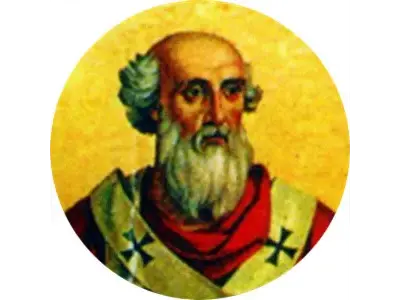
Pope Stephen III was the bishop of Rome and ruler of the Papal States from 7 August 768 to his death. Stephen was a Benedictine monk who worked in the Lateran Palace during the reign of Pope Zachary. In the midst of a tumultuous contest by rival factions to name a successor to Pope Paul I, Stephen was elected with the support of the Roman officials. He summoned the Lateran Council of 769, which sought to limit the influence of the nobles in papal elections. The Council also opposed iconoclasm.
