Louis Armstrong Quotes
President Eisenhower is two faced and has no guts.
Armstrong rarely commented on politics (see {615854}), but the Governor defying the Supreme Court and not letting his people even go to school with other students was too much for him. He not only made the statement, but he approved it for publication. This shocked many who knew him as an apolitical person. He was particularly distressed with President Eisenhower who although he had warned Faubus that he would enforce the court order and then used federal troops to do so, Eisenhower was a man of action and not rhetoric and his lack of firm public statements overlooked an opportunity to use the Presidential “bully pulpit” and exercise his moral leadership and authority. Many then, and even 50 years later, were not sure where he stood on the issue of school desegregation.
Louis Armstrong, 1901-1971, Musician & Entertainer, Statement to reporter, Larry Lubenow in Grand Forks, ND, when Arkansas Governor Faubus ordered the national guard to, despite a court order to the contrary, prevent Black students from integrating Central High School in Little Rock, 1957
Sourced by: Eigen's Political and Historical Quotations

Arkansas Governor Faubus ordered the national guard to prevent Black students from integrating Central High School in Little Rock. President Eisenhower was a man of action and not rhetoric and his lack of firm public statements overlooked an opportunity to use the Presidential “bully pulpit” and exercise his moral leadership and authority. Armstrong was irate at Eisenhower for appearing to do nothing and say nothing. See {615852}. When Eisenhower did enforce the court order and used Federal troops, Armstrong sent him this congratulatory telegram. His reference to walking into the schools was in support of many who suggested that the best thing the President could have done was to personally take one of the Black students by the hand and walk into the school with him or her. With the mood of the Southern racists, such an act was potentially very risky for the President and it is not known whether of not the President and his staff ever considered such an act.
Armstrong rarely commented on politics (see {615854}), but the Governor defying the Supreme Court and not letting his people even go to school with other students was too much for him. He not only made the statement, but he approved it for publication. This shocked many who knew him as an apolitical person. He was particularly distressed with President Eisenhower who although he had warned Faubus that he would enforce the court order and then used federal troops to do so, Eisenhower was a man of action and not rhetoric and his lack of firm public statements overlooked an opportunity to use the Presidential “bully pulpit” and exercise his moral leadership and authority. Many then, and even 50 years later, were not sure where he stood on the issue of school desegregation. See {615852}.


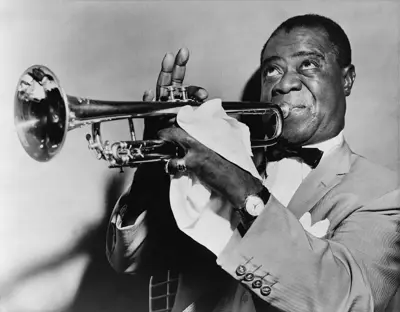
Louis Daniel Armstrong, nicknamed "Satchmo", "Satch", and "Pops", was an American trumpeter and vocalist who was among the most influential figures in jazz. His career spanned five decades and different eras in the history of jazz.
