Gerald R. Ford Quotes
Dumping Rockefeller from the ticket was the most cowardly thing I have ever done.
Ford assumed the Presidency upon Nixon’s Watergate resignation. He was the only President in history who had never been elected to national office. When he pardoned Nixon he lost much of his support from the left and the middle. Weakened, he came under the influence of the very conservative wing of the Republican Party who urged him to dump his Vice President Nelson Rockefeller from the Republican ticket in the 1976 election. Rockefeller was a liberal republican who supported abortion rights and civil rights. Rockefeller, realizing that Ford’s nomination was in danger, volunteered to step down. {641394} Ford accepted and regretted his action as soon as he had done it. The result was that Ford lost to a relatively unknown Southern governor, Jimmy Carter. However the Conservative wing of the Republican Party had triumphed and the liberal republicans, who had been the backbone of the Republican Party since its inception did not play a significant role in the party for the next 30 years.
Gerald R. Ford, 1913–2006, 38th President of the United States (Republican, MI), Speaker of the House, Statement to Presidential Assistant James M. Cannon, Quoted on C-SPAN Radio, May 14, 2006
Sourced by: Eigen's Political and Historical Quotations


The Slavery issue was so contentious that many Northern Congressmen had just given up on the abolitionist cause or never agreed with it even though in many areas of the country the majority of their constituents supported abolition.


Referring to political columnist Drew Pearson:

Armstrong rarely commented on politics (see {615854}), but the Governor defying the Supreme Court and not letting his people even go to school with other students was too much for him. He not only made the statement, but he approved it for publication. This shocked many who knew him as an apolitical person. He was particularly distressed with President Eisenhower who although he had warned Faubus that he would enforce the court order and then used federal troops to do so, Eisenhower was a man of action and not rhetoric and his lack of firm public statements overlooked an opportunity to use the Presidential “bully pulpit” and exercise his moral leadership and authority. Many then, and even 50 years later, were not sure where he stood on the issue of school desegregation.

The event that triggered the call was President Lyndon Johnson introducing the Voting Right Act. Russell had been a mentor to the young Johnson, a fellow Southerner who had voted against and blocked all civil rights legislation when he was in the House and Senate. However when he became President, his representation changed and he reverted to his pre-political views. {637651}


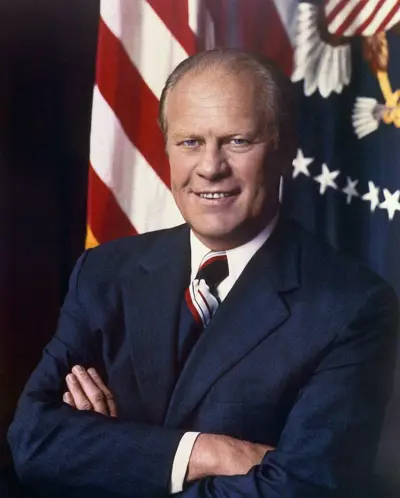
- Born: July 14, 1913
- Died: December 26, 2006
- Nationality: American
- Profession: President
Gerald Rudolph Ford Jr. was an American politician and attorney who served as the 38th president of the United States from 1974 to 1977. A member of the Republican Party, Ford previously served as the 40th vice president of the United States from 1973 to 1974. To date, Ford is the only person to have served as both vice president and president without being elected to either office by the Electoral College.
