Oliver Wendell Holmes Jr. Quotes
The criterion of constitutionality is not whether we believe the law to be for the public good.
Oliver Wendell Holmes Jr., 1841-1935, U. S. Supreme Court Justice, Dissent, Adkins v. Children’s Hospital, 1923
Sourced by: Eigen's Political and Historical Quotations


Despite Ziglar’s and other officials pointing out the illegality, illegal sweeps and arrests were made without warrants or constitutional requirements.


This quotation supports the concept of judicial interpretation of the Constitution in the light of new events or discoveries.
Marshall is famous for, as Chief Justice, establishing the principle that the Judiciary can override Congress and the Executive in determining Constitutionality. However, as this quotation illustrates this principle had been discussed in open debate on the ratification of the Constitution. It was not simply a grab for power by a Chief justice; he uttered this quotation long before he ever suspected he would be a judge but actually spent much of his career in the executive and legislative branch of government.


Cummings was arguing against a Constitutional amendment. His alternative led to Roosevelt's court packing schema.


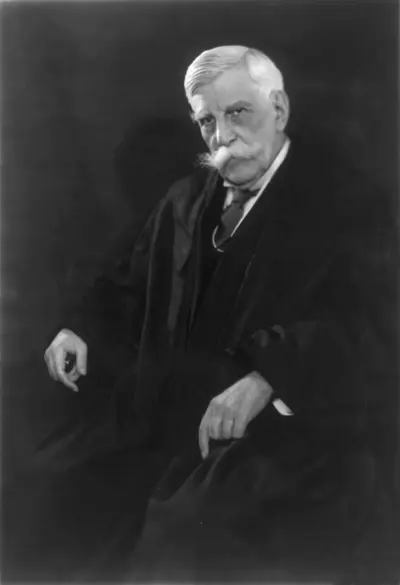
Oliver Wendell Holmes Jr. was an American jurist who served as an Associate Justice of the Supreme Court of the United States from 1902 to 1932. Noted for his long service, concise and pithy opinions, and deference to the decisions of elected legislatures, he is one of the most widely cited United States Supreme Court justices in history, particularly for opinions on civil liberties and American constitutional democracy, and is one of the most influential American common law judges, honored during his lifetime in Great Britain as well as the United States. Holmes retired from the court at the age of 90, an unbeaten record for oldest justice in the federal Supreme Court (although John Paul Stevens was only 8 months younger when he retired on April 12, 2010). He previously served as an Associate Justice and as Chief Justice of the Massachusetts Supreme Judicial Court, and was Weld Professor of Law at his alma mater, Harvard Law School.
