Ruhollah Khomeini Quotes
Superfluous bureaucracies and the system of file-keeping and paper-shuffling that is enforced by them … are totally alien to Islam
He confuses modernity and religion. Muslims who live in a modern world have the same degree of bureaucracy then the Christians, Jews, Hindus, Buddhists and other religions do. The Muslims of America have the same degree of paperwork as other Americans, and the Turkish bureaucracy has as much filing and other paperwork as countries where the majority of people are of different religions. Historically, when England and France and other Christian countries were in the Dark Ages, Islamic bureaucrats kept Western and Eastern knowledge alive, and when the Ottoman Empire ruled most of the known world, they almost collapsed under their very heavy bureaucracy.
Ruhollah Khomeini, 1900-1989, Iranian High Cleric (Ayatollah) & Revolutionary Leader, Islam and Revolution
Sourced by: Eigen's Political and Historical Quotations


Theological & Legal Expert. The Sunnah, like the Koran, has statements of the Prophet, Mohammad. A fatwa is a religious legal ruling. This particular Fatwa shows the great difference between the Islamic State and a Republic or Democracy. In the latter forms, any religious practices must be consistent with the Constitution. Even though blasphemy might be prohibited by a religion, the United States Constitution for example protects anyone’s right to be blasphemous. In the Islamic system any constitution or law is subservient to and must be consistent with, the sayings of the Prophet Muhammad. In that sense, unless the Muslim populated nation is secular like Turkey, then the governments are partial or total theocracies.


This is not terribly different however from Christians and Jews selectively quoting the Bible.


They are so different that most people in the West think of what Khamenei describes as “religious democracy” as not even close to democracy—almost the antithesis of democracy, and Islamic fundamentalists perceive Western democracy as sinful and evil.


Jefferson is the hero of the “small government” enthusiasts of modern times. In his day it was the conservative Federalists who wanted a larger government while the Jeffersonians, the radicals of the day argued for smaller government. Jefferson not only favored smaller government, but he actually cut the size of the Federal workforce something which in modern times no president has done except for William Clinton.

Legal Religious Ruling. This is an example of a source of tension between some Muslims and others. Non-Muslims are required to have a Muslim Education in Muslim countries, but they insist that any required Christian or secular education in a non Muslim country is anti-Islamic.
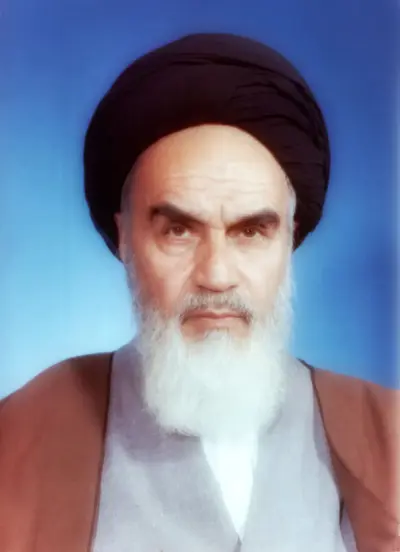
Sayyid Ruhollah Musavi Khomeini, also known in the Western world as Ayatollah Khomeini, was an Iranian political and religious leader. He was the founder of the Islamic Republic of Iran and the leader of the 1979 Iranian Revolution, which saw the overthrow of the last Shah of Iran, Mohammad Reza Pahlavi, and the end of the 2,500-year-old Persian monarchy. Following the revolution, Khomeini became the country's Supreme Leader, a position created in the constitution of the Islamic Republic as the highest-ranking political and religious authority of the nation, which he held until his death. Most of his reign was taken up by the Iran–Iraq War of 1980–1988. He was succeeded by Ali Khamenei on 4 June 1989.
