Mahatma Gandhi Quotes
So far as I can see the atomic bomb has deadened the finest feeling that has sustained mankind for ages.
Gandhi, Mahatma. "Atom Bomb and Ahimsa." Harijan, 7 July 1946.


Breslin was criticized in a Federal report for his alarmist news coverage of the Three Mile Island nuclear mishap:


The concept of Mutually Assured Destruction (MAD) has inhibited the use of atomic weapons since WWII. If one nuclear nation attacked another, the attacked nation would still have time to retaliate and both countries would be destroyed. However, Iran by their own statements and past history might not be inhibited by large losses and death in retaliation. Iran, a theocracy, has a religion that believes that any Muslim who is killed in defense of Islam will immediately go to heaven. They have sacrificed hundreds of thousands of their citizens in their war with Iraq. Iran is a much larger country than Israel where a single nuclear bomb would destroy the whole nation. One retaliatory bomb would do terrible damage to Iran but much more of the country and its people would survive. The Iran fanatics might make such a tradeoff as a religious obligation. This is why, most of the world is doing much to prevent Iran from getting a nuclear weapon at all. Rafsanjani’s logic however assumes that if Iran fired one bomb, Israel would retaliate with one bomb. However, Israel has the capability of carpeting all of Iran with a nuclear muti-warhead retaliation so Iran would also be completely destroyed. However Israeli policy has been to never discuss anything about nuclear weapons and their policies. Some ultra-fanatical Muslims have argued that even of all of Iran and its people were destroyed, this would be a worthwhile “martyrdom” so that the remainder of the Muslim world would be free of Israel. This is illustrative of how difficult it is negotiating with religious fundamentalists who control a nation.

This quotation represents a colossal failure of politicians to understand science and the way that it works. They assumed that the processes and methods were secrets that if kept secret, would prevent others from constructing an atomic bomb. The reality was that the most important “secrets” had emanated from Einstein’s Theory of Relativity and other published scientific papers. So any competent physicist knew immediately how the bomb worked. A triggering mechanism would need to be developed but that was just a complicated engineering project. The largest barrier was the supply of enough radioactive material with sufficient purity. That then (as today) took a lot of money and some time. But after the initial bomb, the secrets might speed things up but were not necessary. That is why the French and the Russians quickly developed their bombs, and why it did not take the Israelis long once the had decided to invest the resources. China, India and Pakistan did not need the secrets either when much later, they decided to develop nuclear weapons. With the atomic bomb, spying and obtaining secrets shorten the required time and reduce the cost, but are not necessary. This is why nuclear proliferation is so hard to stop.

The Scientific Project that developed the Atomic Bomb. Oppenheimer was the great physicist who directed the successful development of the atomic bomb so as to build the weapon before Hitler did in World War II. However, as the technology evolved, he had doubts as to the wisdom of creating even more powerful hydrogen weapons. His viewpoint was hurting the administration’s policy of rapid unlimited nuclear weapons development, and he was the victim of a character assassination whereby his security clearance was withdrawn. The “father” of the atomic bomb was the first American casualty of atomic weapons development.

he cupped his two hands Fermi was the scientist who organized and planned the first controlled nuclear chain reaction


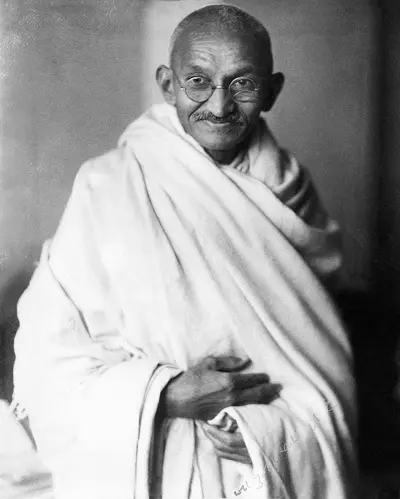
Mohandas Karamchand Gandhi was an Indian lawyer, anti-colonial nationalist, and political ethicist, who employed nonviolent resistance to lead the successful campaign for India's independence from British rule, and in turn inspired movements for civil rights and freedom across the world. The honorific Mahātmā (Sanskrit: "great-souled", "venerable"), first applied to him in 1914 in South Africa, is now used throughout the world.
