Robert Scheer Quotes
I happen to love America. I love this freedom and democracy. The fact is we are the ones who killed innocent people, men, women and children, in Hiroshima and Nagasaki with nuclear weapons, weapons that should have never been used, should have never been developed in the first place, you know?
Scheer, Robert. Interview with Brian Lamb. Q&A, C-SPAN, 28 May 2006.


The only soldier ever so honored

The Scientific Project that developed the Atomic Bomb
The Scientific Project that developed the Atomic Bomb. Oppenheimer was the great physicist who directed the successful development of the atomic bomb so as to build the weapon before Hitler did in World War II. However, as the technology evolved, he had doubts as to the wisdom of creating even more powerful hydrogen weapons. His viewpoint was hurting the administration’s policy of rapid unlimited nuclear weapons development, and he was the victim of a character assassination whereby his security clearance was withdrawn. The “father” of the atomic bomb was the first American casualty of atomic weapons development.


There were some doubts the scientists developed after Germany had surrendered as Hitler had been their greatest fear. So they were briefed on the planned invasion of the Japanese mainland and the military medical preparations for treating and caring for ½ million serious wounded casualties. In addition, given the state of war, there was expected about the same number of American Military deaths. On top of that, there would be many more Japanese military casualties plus even more Japanese civilian deaths and wounded. The use of the Atom Bomb would save all those lives but have casualties of its own, but far fewer. At the time, surprising to most people now, the use of the atomic bomb was not an issue of controversy at all. There were no Congressman who questioned it, no newspapers which editorialized against the use of the bomb. There were not even any other counties which protested its use.

This quotation represents a colossal failure of politicians to understand science and the way that it works. They assumed that the processes and methods were secrets that if kept secret, would prevent others from constructing an atomic bomb. The reality was that the most important “secrets” had emanated from Einstein’s Theory of Relativity and other published scientific papers. So any competent physicist knew immediately how the bomb worked. A triggering mechanism would need to be developed but that was just a complicated engineering project. The largest barrier was the supply of enough radioactive material with sufficient purity. That then (as today) took a lot of money and some time. But after the initial bomb, the secrets might speed things up but were not necessary. That is why the French and the Russians quickly developed their bombs, and why it did not take the Israelis long once the had decided to invest the resources. China, India and Pakistan did not need the secrets either when much later, they decided to develop nuclear weapons. With the atomic bomb, spying and obtaining secrets shorten the required time and reduce the cost, but are not necessary. This is why nuclear proliferation is so hard to stop.
Germany had some world class physicists. Our scientists, military intelligence people, and political leadership assumed that the Germans were also seeking to develop the Atomic Bomb. Ironically, it turned out that they were not, and what Truman reported in this quotation was untrue (although that was not fully known at the time.) Einstein and several of the scientists who were early pioneers in modern physics were Jewish, and Hitler referred to the study of nuclear fission and fusion as “Jewish Science.” As a result, the German government did not commit the resources to the development of an atomic bomb. Instead, they were betting on the development of the Jet Airplane which they succeeded in deploying against the Allies at the end of the war. But they did not have enough or enough pilots left alive to fly them, and Germany was overrun by the Allied Troops. Prior to Truman’s erroneous report about the German development of an atomic bomb, there had only been one piece of evidence that the Germans were not developing one. An OSS secret agent, Moe Berg, had talked with Werner Heisenberg, at a Swiss scientific conference during the war. He was going to assassinate the greatest of the German physicists if Berg thought he was working on a nuclear device. Berg concluded from his discussions that Heisenberg did not know enough about nuclear fission to have been working on that. Berg did not kill Heisenberg, and reported that he did not think the Germans were developing a bomb as if they were Heisenberg would have been deeply involved. However, the American intelligence people and the American scientists, did not trust Berg’s analysis and conclusion. Berg was not a trained scientist. He was a professional baseball player—the NY Yankee backup catcher to Bill Dickey. He was a college graduate, a brilliant guy and a very fast learner who had studied physics books and papers before his assignment. Berg turned out to have been right, but that was not confirmed until a few years after the war. Truman had relied on an incorrect intelligence estimate when he made this quotation. It was not the first such error of intelligence analysis in American history and it would not be the last.


Bombing had reached the point where conventional bombing raids on industrial cities like Tokyo and Hamburg produced even more civilian casualties than did the atomic bomb at Hiroshima. Tibbets’ view, through the lens of hindsight, was developed by many of the Allied servicemen who had been forced into war by expansionist and militaristic nations like Japan and Germany both of which placed much of their war material manufacturing capability in the midst of their otherwise civilian cities. Both brutally violated the laws of war and committed atrocities many times over before the allies began retaliating. There are still some who believe that it was wrong to drop the atomic bomb on Japan. Some even feel that the mass bombing of Japanese and German cities in retaliation and in furtherance of the war effort was morally wrong. But at the time, the millions of casualties anticipated in the invasion of the Japanese mainland, persuaded virtually every American soldier and civilian that there was nothing wrong with use of the Atomic bomb, and many saw it as an absolute Godsend to prevent all the American and Japanese causalities that would have come otherwise. Many scholars remark on how it was virtually impossible to find any significant number of misgivings before or just after Hiroshima. Tibbet’s view was typical.

On March 9-10, 1945, over three hundred B-29 Superfortresses, loaded with 2,000 tons of incendiary bombs flew over Tokyo bombing the city in waves for 6 hours. Over 250,000 buildings were destroyed and more people killed than would be in either Hiroshima or Nagasaki which were destroyed by atomic bombs. The fact that the Japanese would not surrender even after such complete destruction of their capital and largest industrial city, was used by American leaders in assessing whether to use the atomic bomb afterwards. There were many who believed that the atomic bomb would not be enough for motivate a Japanese surrender as Japanese culture prohibited surrender. Indeed, even after the 1st atomoc bomb, the Japanese did not surrender, and after the 2nd, the war council was split 3-3 and the Emperor historically broke the tie. Even the atomic bomb might not have worked. Later generations found this resistance to surrender hard to understand but Japanese culture was amazingly strong then.

Although generally a right wing conservative, Clark today sounds like almost like an extreme leftist on the issue. At the time however, many thought that he had taken leave of his senses. He not only was completely contrary to bipartisan national policy but opposed by almost universal American public opinion. He is one of the very few significant American officials to oppose the war policies.

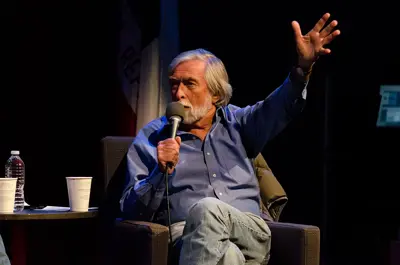
Robert Scheer is an American journalist who has written for Ramparts, the Los Angeles Times, Playboy, Truthdig, Scheerpost and other publications as well as having written many books. His column for Truthdig was nationally syndicated by Creators Syndicate in publications such as The Huffington Post and The Nation. He is a clinical professor of communications at the Annenberg School for Communication & Journalism at the University of Southern California. Scheer is the former editor in-chief for the Webby Award-winning online magazine Truthdig. For many years, he co-hosted the nationally syndicated political analysis radio program Left, Right & Center on National Public Radio (NPR), produced at public radio station KCRW in Santa Monica. The Society of Professional Journalists awarded Scheer the 2011 Sigma Delta Chi Award for his column.
